



Canada's labour market finally caught a bit of a break in June
Labour Force Survey June 2026
July 10, 2026
3 min read

Anupriya Gangopadhyay
Share:




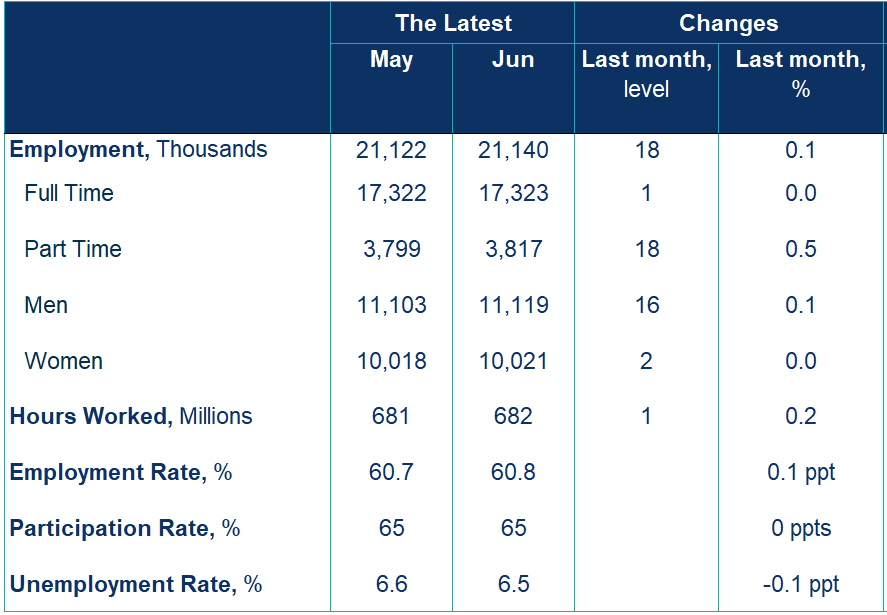
Unemployment rate fell for a second straight month to 6.5%, youth hiring picked up, and wage growth strengthened to 3.3% year over year. Employment, on the other hand, rose by 18,000 — pushing the employment rate up to 60.8%.
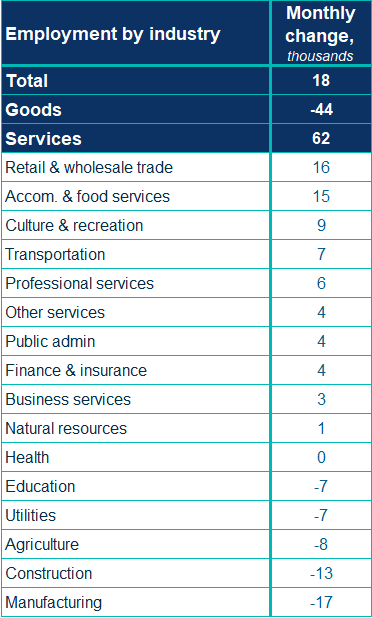
The recovery is still uneven. Manufacturing, agriculture, and utilities all lost jobs, reminding us that some sectors of the economy continue to face pressure. While some of the recent volatility in the market appears to be easing, broader global and trade uncertainty still cloud the outlook. We expect the Bank of Canada to hold its policy rate at 2.25% for a sixth consecutive decision.
Key Takeaways
- Employment Levels: Employment was a little changed in June, rising by 18,000 (+0.1%), following a much stronger 88,000-job gain in May. The employment rate edged up 0.1 percentage points to 60.8%, returning to its January level, while year-over-year employment growth remained modest at99,000 (+0.5%). The June data suggest the labour market is stabilizing after earlier weakness, but the pace of job creation remains subdued.
- Unemployment and Participation Rates: The unemployment rate declined for a second consecutive month, falling 0.1 percentage points to 6.5%, matching the rate last seen in January. The participation rate held steady at65.0%, indicating that the decline in unemployment was not driven by a shrinking labour force. The job-finding rate also improved to 24.3%, up from 21.3% a year earlier, pointing to a modest improvement in labour market absorption.
- Demographics and Job Types: Employment gains were concentrated amongyouth aged 15 to 24 and core-aged workers aged 25 to 54, each adding 33,000 jobs in June. Youth unemployment fell sharply by 0.7 percentage points to 12.7%, supported mainly by part-time employment gains, while unemployment among core-aged men and women held steady. However, employment among workers aged 55 and older declined by 47,000, highlighting continued unevenness across age groups.
- Sectoral Breakdown: Industry performance remained mixed in June. Employment rose in accommodation and food services (+15,000), marking the sector’s third consecutive monthly increase, while losses were concentrated in manufacturing (-17,000), agriculture (-7,600) and utilities (-7,300). Manufacturing remains a key weak spot, with employment down 61,000 from its January 2025 peak, amid ongoing tariff-related uncertainty.
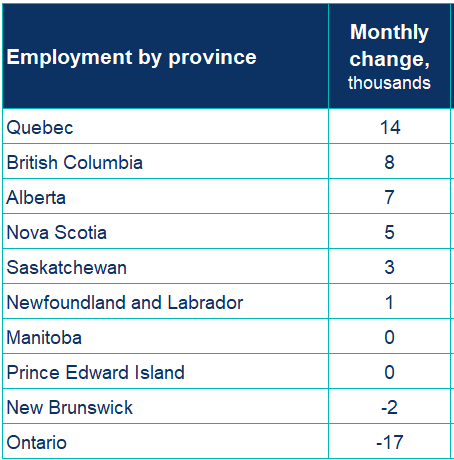
- Provincial Trends: Provincial labour market performance was relatively muted, with employment little changed in most provinces. The notable gains came from Quebec edged higher for a second consecutive month (+14,000), Nova Scotia (+4,800) and Saskatchewan (+2,900), and Ontario held steady after two months of gains. Unemployment rates improved in several major markets, including Quebec, British Columbia and Montréal, but Ontario’s unemployment rate remained unchanged at 7.0%.
Tables
Other Blogs

Record Exports Signal a Broader Trade Story: Merchandise Trade May 2026

Canada’s economy starts the second quarter with firmer footing

The Inflation Gap Widens as Price Pressures Spread Beyond Energy: May 2026 CPI

Consumers Keep Spending, but the Menu Is Narrowing

The Bank of Canada faces a dilemma as it extends its holding pattern

Canada’s Trade Story Finds New Supporting Cast: Merchandise Trade April 2026

It is green across the board for May’s labour market: Labour Force Survey May 2026

Where Canada’s defence debate goes next