



Record Exports Signal a Broader Trade Story
Merchandise Trade May 2026

Jasleen Trehan
Share:




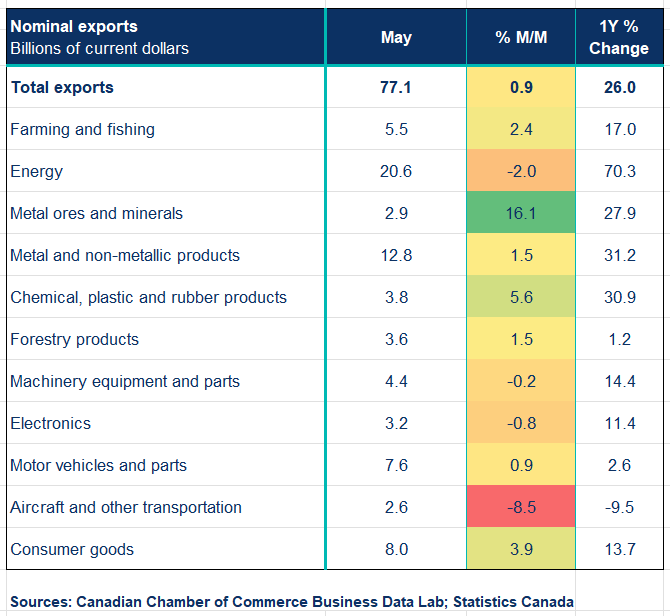
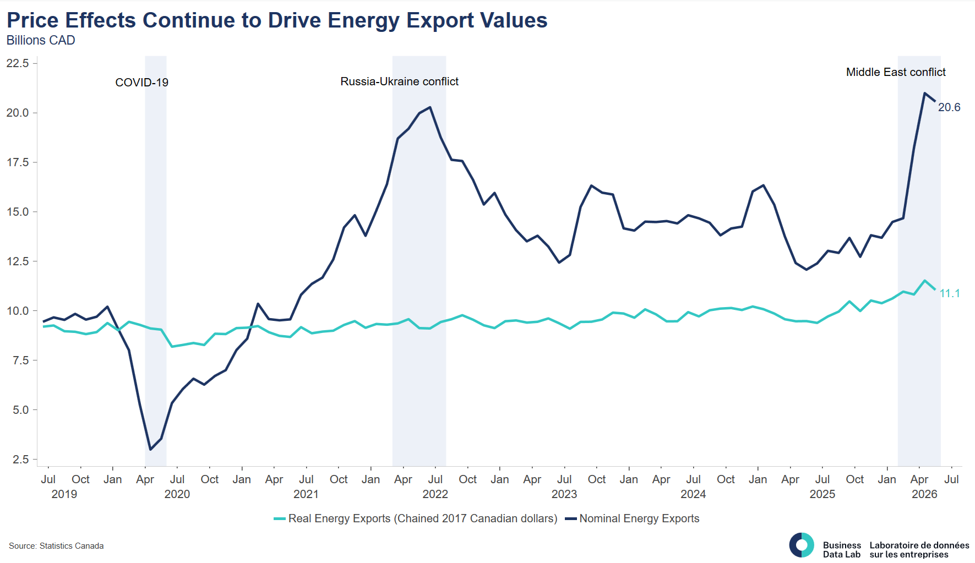
With the latest merchandise trade numbers out, we’ve gone from tilted to a more even picture. The headlines are impressive: record exports of $77.1 billion, a fourth straight monthly increase and third consecutive merchandise trade surplus. However, the real story is that growth is no longer resting on a single pillar. Critical minerals, aluminum, chemicals and consumer goods helping diversify Canada’s export mix. While real export volumes were essentially unchanged, suggesting higher prices boosted headline export values, the underlying composition of exports is becoming more balanced.
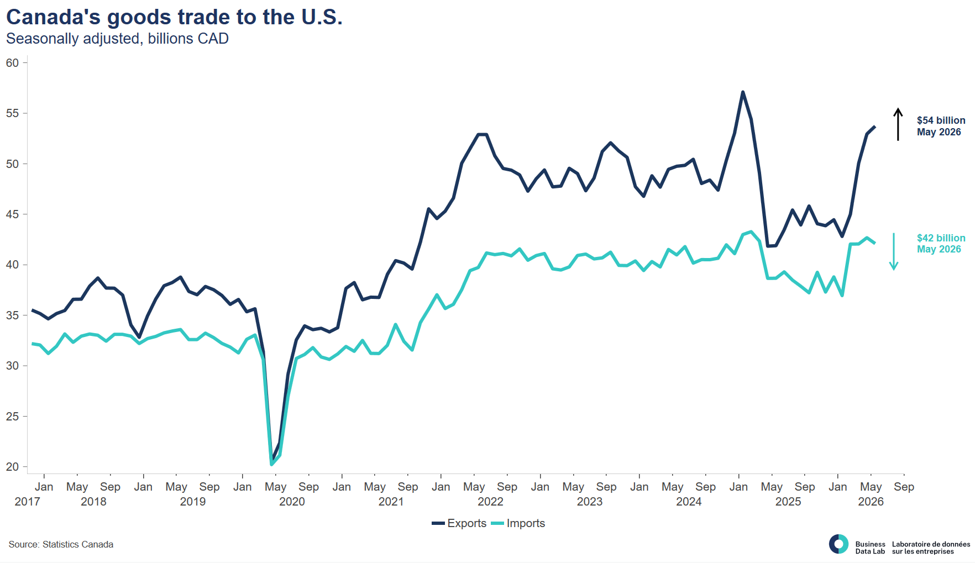
Despite efforts to diversify, the United States remains our primary export market, with exports rising for a fourth consecutive month and lifting Canada’s trade surplus with its largest trading partner to $11.6 billion — the highest since January 2025. Beyond the U.S., however, diversification remains uneven, as gains in some markets continue to be offset by weakness in others.
The next challenge is to make sure this momentum is driven by stronger export volumes, not just higher prices. That’s what will determine whether today’s gains translate into long-term economic growth or not.
Headline
Canada’s merchandise exports reached a record $77.1 billion in May, while imports edged down 0.2%, widening the trade surplus to $4.2 billion. Exports have now risen 22.2% since February, reflecting strong nominal momentum. However, real export volumes were essentially unchanged, suggesting higher prices continued to support headline values. The positive story is composition: growth broadened beyond energy, pointing to a more balanced export mix.
Key Takeaways
- Exports: Merchandise exports increased 0.9% to a record $77.1 billion, marking a fourth consecutive monthly increase and a third straight trade surplus, reflecting continued strength in Canada’s external sector. Gains were recorded in 7 of 11 product categories, led by metal ores and non-metallic minerals (+16.1%), consumer goods (+3.9%), and chemical, plastic and rubber products (+5.6%). While energy exports declined 2.0%, exports excluding energy increased 2.0%, highlighting broader strength across non-energy sectors. However, the strength remained largely in nominal terms, as real export volumes were essentially unchanged, suggesting higher prices continued to support headline export values. Even so, stronger contributions from non-energy sectors point to a broader and more balanced export base.
- Imports: Merchandise imports edged down 0.2%, primarily reflecting an 18.2% decline in metal and non-metallic mineral products, driven by lower gold imports following elevated shipments in April. The decline was partly offset by stronger imports of consumer goods (+3.5%), industrial machinery (+2.8%), chemicals (+3.8%), and motor vehicles (+1.2%). Import volumes, however, rose 0.4%, indicating domestic demand remained resilient despite softer nominal import values.
- Trade with the United States and Non-U.S. Markets: Trade with the United States continued to strengthen, with exports rising 1.5% for a fourth consecutive month while imports declined 1.4%, widening Canada’s bilateral trade surplus to $11.6 billion—its highest level since January 2025. The increase reflected continued strength in shipments to Canada’s largest trading partner. By contrast, exports to non-U.S. markets edged down 0.3%, as weaker gold shipments to the United Kingdom offset stronger exports to markets such as the Netherlands and Switzerland. The release suggests Canada continues to diversify its export markets, although progress remains uneven.
- Services exports: Services exports increased 0.9%, while services imports rose 2.0%, widening Canada’s services trade deficit. Nevertheless, stronger merchandise trade more than offset this deterioration, lifting Canada’s combined goods and services trade surplus to $3.8 billion, up from $3.2 billion in April and reinforcing the positive contribution of trade to the overall external balance.
- Overall Picture: May’s release highlights an important shift in Canada’s trade story. Export growth is becoming increasingly diversified across industries, reducing reliance on a handful of sectors even as higher prices continue to support headline values. If this broader participation is matched by stronger real export volumes in the coming months, trade should remain a constructive contributor to Canada’s economic growth through the second quarter.
Implications
- Canada’s export base is becoming more balanced. Stronger growth across non-energy sectors points to a healthier and more resilient export mix, reducing reliance on any single industry.
- The U.S. remains Canada’s key growth market. Continued strength in exports to the U.S. reinforces the importance of the bilateral trading relationship, while diversification into other markets remains gradual.
- Trade appears well positioned to support second-quarter GDP, although stronger gains in real export volumes will be needed to ensure today’s record export values translate into sustained economic growth.
Sources: Statistics Canada; Canadian Chamber of Commerce Business Data Lab
Other Blogs

Consumers Return to the Checkout with Broader Spending

Inflation cools ahead of the summer months

The Bank of Canada gains more confidence in growth prospects despite inflation risk

Canada’s labour market finally caught a bit of a break in June: Labour Force Survey May 2026

Canada’s economy starts the second quarter with firmer footing

The Inflation Gap Widens as Price Pressures Spread Beyond Energy: May 2026 CPI

Consumers Keep Spending, but the Menu Is Narrowing

The Bank of Canada faces a dilemma as it extends its holding pattern