



Consumers Keep Spending, but the Menu Is Narrowing
Retail sales April 2026

Jasleen Trehan
Share:




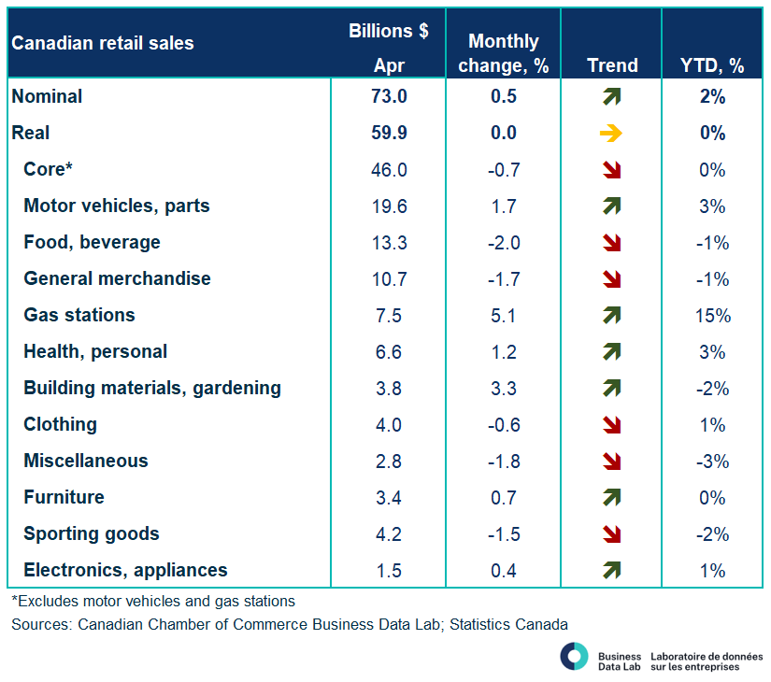
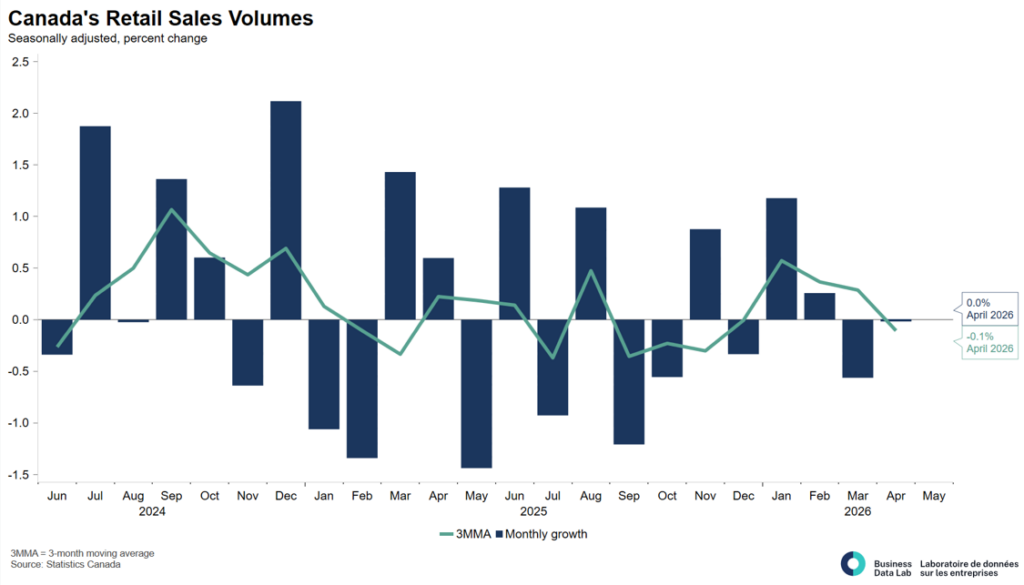
Canada’s consumer appetite remians healthy, but April suggests the spending diet is becoming less balanced. Retail sales rose 0.5%, yet much of the progress came from gasoline stations and auto dealers, while core retail sales fell 0.7% for a second consecutive month and volumes were essentially flat.
Canadians continue to spend on fuel and vehicles, but spending on everyday categories such as groceries and general merchandise weakened noticeably in April.
The encouraging news is that Statistics Canada’s advance estimate points to another increase in May, suggesting the consumer remains resilient and the economy is still on track for a good first half of the year. But the road ahead looks less certain. A softening labour market, lingering trade uncertainty, and renewed energy-driven inflation pressures could make it increasingly difficult for households to maintain the same pace.
Key Takeaways
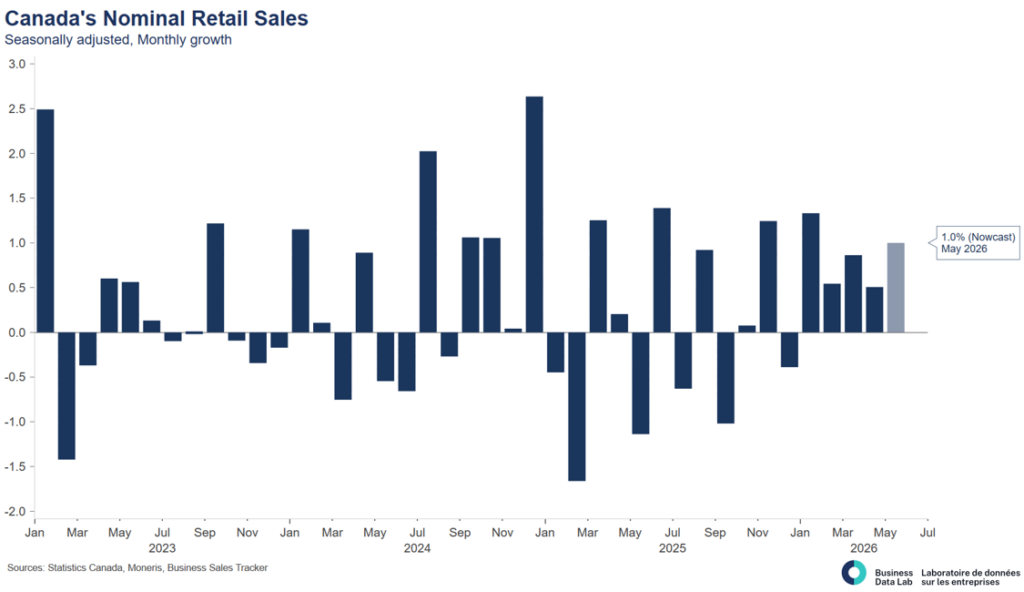
- Overall performance: Retail sales rose 0.5% m/m to $73.0B in April, marking a fourth consecutive monthly increase. However, real (volume) sales were essentially unchanged, while core retail sales fell 0.7%, extending March’s decline. The result is a growing gap between nominal spending and actual consumption, suggesting households are still spending more dollars but not necessarily buying more goods.
- Strengths: Growth was concentrated in gasoline stations (+5.1%) and motor vehicle and parts dealers (+1.7%), which together accounted for most of the monthly increase. Higher fuel prices boosted spending at the pump, while vehicle purchases continued to support headline sales. Health and personal care stores (+1.2%) also remained resilient, indicating consumers are still prioritizing essential spending categories.
- Weakness: Underlying demand softened further. Food and beverage retailers (-2.0%), including grocery stores (-2.7%), and general merchandise stores (-1.7%) posted notable declines. Combined with a second consecutive drop in core retail sales and flat volumes, the data suggest consumers are becoming more selective and increasingly concentrating spending in a smaller number of categories.
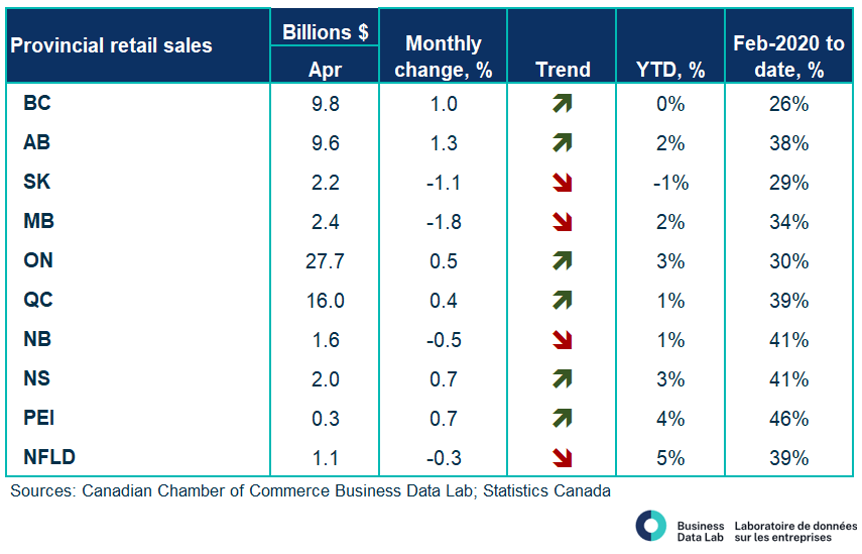
- Regional trends: Sales increased in six provinces, led by gains in Alberta and Ontario, supported by stronger energy-related and vehicle spending. However, declines in several provinces and weakness in some major urban markets suggest consumer momentum is becoming less broadly based than earlier in the year, reinforcing the theme of uneven growth.
- Advance estimate: Statistics Canada’s advance estimate points to a 1.0% increase in May, indicating consumer spending remained resilient through the spring. While this supports a solid first half of 2026, the quality of growth is becoming narrower, with headline gains increasingly dependent on gasoline and auto-related spending rather than broad-based consumer demand.
The April report suggests the Canadian consumer remains resilient, but the foundation beneath that resilience is becoming less balanced. While positive momentum is likely to carry through the second quarter, weakening core spending and flat volumes point to softer underlying demand. As rising energy costs and ongoing uncertainty continue to pressure household budgets, consumers may find it increasingly difficult to maintain the same pace of spending seen earlier in the year.
Charts and Tables
Other Blogs

Consumers Return to the Checkout with Broader Spending

Inflation cools ahead of the summer months

The Bank of Canada gains more confidence in growth prospects despite inflation risk

Canada’s labour market finally caught a bit of a break in June: Labour Force Survey May 2026

Record Exports Signal a Broader Trade Story: Merchandise Trade May 2026

Canada’s economy starts the second quarter with firmer footing

The Inflation Gap Widens as Price Pressures Spread Beyond Energy: May 2026 CPI

The Bank of Canada faces a dilemma as it extends its holding pattern