



Canada’s Trade Story Finds New Supporting Cast
Merchandise Trade April 2026

Jasleen Trehan
Share:




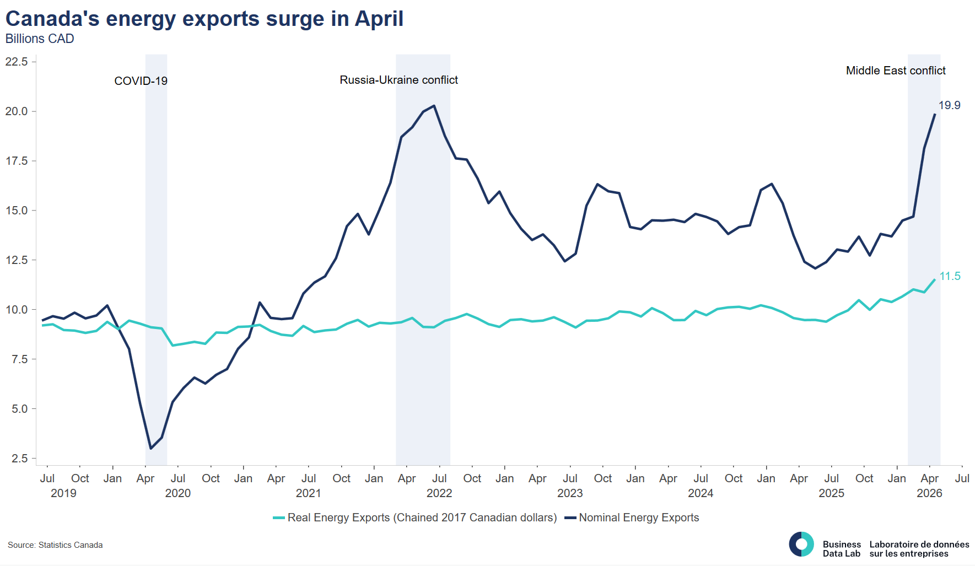
For the first time in a while, Canada’s trade story feels less like another season of the same show. Energy remains the star, but April introduced a few new characters – autos, machinery, aircraft and agriculture that helped push exports to a record high.
That’s an encouraging shift because, for much of the past year, commodity swings in energy and gold have dominated the storyline. This month, gold moved sharply in the opposite direction and yet exports still advanced, suggesting there is finally more supporting the trade sector than a handful of volatile products.
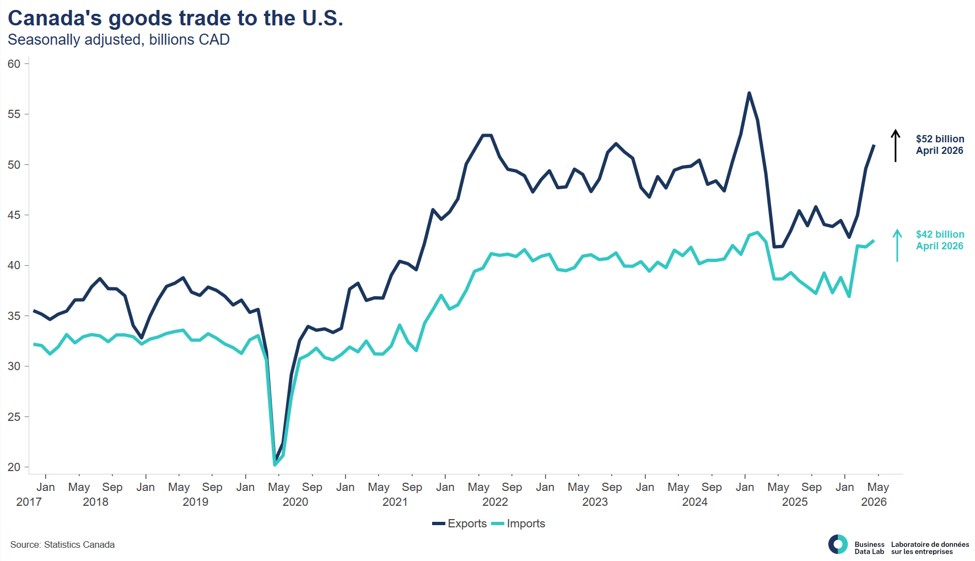
The United States continues to be Canada’s box-office hit. Exports south of the border rose for a third consecutive month, pushing the trade surplus with our largest trading partner to its highest level since February 2025. The diversification story, however, remains unfinished. While exports to China reached a record high, overall exports to non-U.S. markets pulled back after March’s surge, showing Canada still has work to do in broadening its customer base.
After a first quarter that ended in a technical recession, this report offers a welcome change in tone. The most encouraging part isn’t the record export number itself – it’s that trade growth is finally showing up in volumes and across more sectors of the economy. For now, that’s a stronger signal of momentum than any headline figure.
Headline
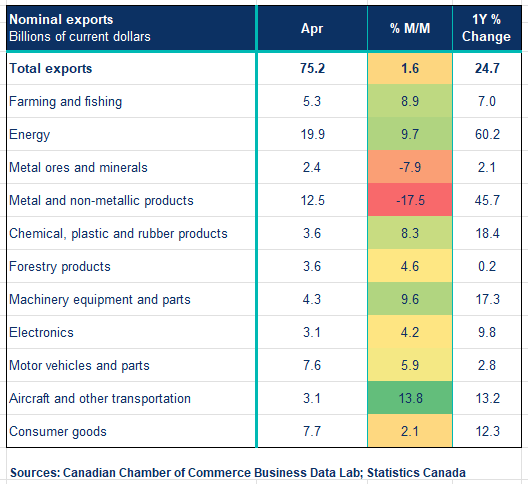
Canada’s merchandise exports rose 1.6% to a record $75.2 billion in April, while imports increased 0.3% to $72.4 billion, resulting in a $2.7 billion trade surplus, the largest since January 2025. Unlike previous months, the improvement was supported by stronger underlying activity, with real export volumes rising 3.0% and import volumes increasing 0.4%. While higher energy prices continued to support trade values, gains were spread across multiple sectors, signalling a broader and more resilient trade performance.
Key Takeaways
- Exports: Merchandise exports increased 1.6%, with gains recorded in 9 of 11 product categories, highlighting broad-based strength. Energy exports rose 9.7%, supported by higher crude oil prices amid geopolitical uncertainty. Additional gains came from motor vehicles and parts (+5.9%), industrial machinery, equipment and parts (+9.6%), aircraft and other transportation equipment (+13.8%), and farm, fishing and intermediate food products (+8.9%). The main offset came from metal and non-metallic mineral products (-17.5%), driven by a sharp decline in unwrought gold exports following March’s surge. Despite a sharp pullback in gold shipments, exports still reached a record high, underscoring broader strength across the export sector.
- Imports: Imports edged up 0.3%, reaching a record $72.4 billion. Higher imports of electronic and electrical equipment (+6.5%), including a record level of computer imports linked to data centre investments, were partially offset by lower imports of metal and non-metallic mineral products (-13.6%), largely reflecting reduced gold imports. The modest increase suggests domestic demand remains stable but not particularly strong.
- Trade with the United States and Non-U.S. Markets: The United States remained Canada’s box-office hit in April. Exports to the U.S. rose 4.8% ($2.6 billion) for a third consecutive month, while imports increased a more modest 1.0% ($0.6 billion). As a result, Canada’s trade surplus with its largest trading partner widened from $7.0 billion to $9.5 billion—the highest since February 2025. Higher crude oil and passenger vehicle exports were the main drivers. Outside the U.S., the story was less encouraging. Although exports to China reached a record high, overall exports to non-U.S. markets fell 4.8%, largely due to lower gold shipments to the United Kingdom. As a result, Canada’s trade deficit with non-U.S. countries widened from $6.0 billion to $6.8 billion, highlighting that diversification remains uneven and heavily influenced by commodity flows.
- Services exports: Service exports increased 0.5%, while service imports rose 0.7%, resulting in a modest widening of Canada’s services trade deficit. Combined goods and services trade remained in surplus, supported primarily by the improvement in merchandise trade.
- Overall Picture: April’s report offers a more constructive trade narrative than Canada has seen in recent months. While energy continues to play a significant role, export growth was supported by a wider range of sectors and accompanied by stronger volumes. Coming after a first quarter that ended in a technical recession, the data suggest that trade could provide more support to growth in Q2 than it did during the first quarter.
Implications
- Export growth seems more balanced, with autos, machinery, aircraft and agriculture contributing alongside energy, reducing reliance on a handful of volatile commodity categories.
- Diversification remains a work in progress. While exports to China reached a record high, broader non-U.S. trade performance continues to be shaped by commodity swings.
- Rising export volumes and a widening trade surplus provide an encouraging start to Q2, suggesting trade could offer modest support to economic growth after a weak first quarter.
Sources: Statistics Canada; Canadian Chamber of Commerce Business Data Lab
Other Blogs

Consumers Return to the Checkout with Broader Spending

Inflation cools ahead of the summer months

The Bank of Canada gains more confidence in growth prospects despite inflation risk

Canada’s labour market finally caught a bit of a break in June: Labour Force Survey May 2026

Record Exports Signal a Broader Trade Story: Merchandise Trade May 2026

Canada’s economy starts the second quarter with firmer footing

The Inflation Gap Widens as Price Pressures Spread Beyond Energy: May 2026 CPI

Consumers Keep Spending, but the Menu Is Narrowing