


The Inflation Gap Widens as Price Pressures Spread Beyond Energy
CPI May 2026

Jasleen Trehan
Share:




Inflation moved above 3% in May as an energy-driven price shock began leaving its fingerprints across the broader economy. Rising fuel costs remain the main driver, but higher prices are increasingly showing up in groceries, fresh produce, air travel, and vacations. Inflation is becoming more visible across household budgets, though it has yet to resemble the broad-based price pressures that defined the post-pandemic surge.
Beneath the headline, the picture remains more reassuring. Shelter costs continue to cool, rent inflation has slowed to its weakest pace in more than four years, and the Bank of Canada’s core inflation measures remain close to target. Taken together, these trends suggest inflation is broadening at the margins rather than reaccelerating across the economy.
For the Bank of Canada, May’s report raises the stakes but not the odds of a policy move. Policymakers can no longer dismiss inflation as solely an energy story, yet a soft economy and easing labour market provide little justification for higher interest rates. The most likely outcome remains a prolonged pause as the Bank watches whether these inflation ripples fade or become more persistent.
Key Takeaways
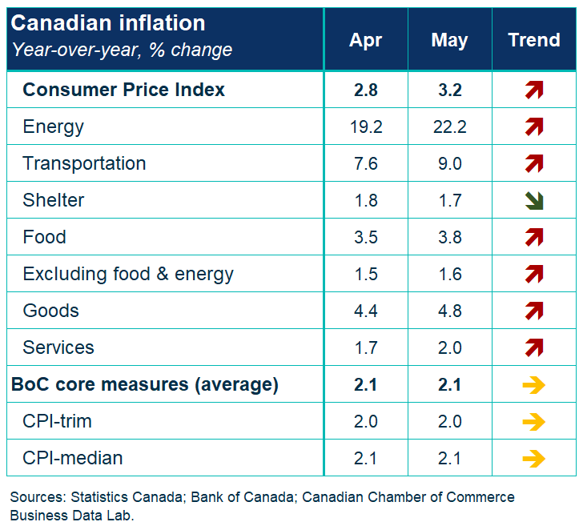
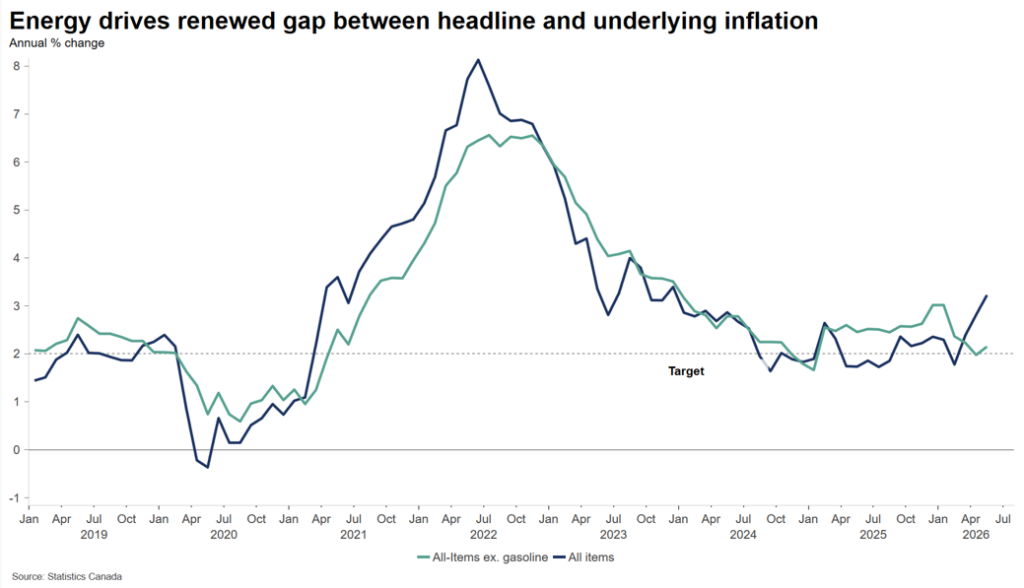
- Headline inflation moved above the Bank of Canada’s 3% upper target band. CPI rose 3.2% year over year in May, up from 2.8% in April, with prices up 1.0% month over month. Gasoline remained the main driver, but CPI excluding gasoline also accelerated to 2.2%, up from 2.0% in April. This suggests the inflation story is still energy-led, but no longer energy-only.
- Core inflation remained near target, but progress has stalled. CPI-trim held at 2.0% and CPI-median remained at 2.1%, suggesting underlying price pressures are stable but no longer easing.
- Gasoline prices rose 33.2% year over year, reflecting elevated global oil prices and ongoing geopolitical supply concerns. The pressure also showed up in travel tours (+8.8%), air transportation (+7.5%), fresh fruit (+5.5%) and vegetables (+9.0%) suggesting higher energy costs are beginning to ripple through other consumer-facing categories. Another notable pocket was computer equipment, software and supplies, which rose year over year for the first time since 2020 as AI data centre demand and limited production capacity lifted input costs.
- Shelter continued to lean against inflation. Shelter inflation eased to 1.7%, rent growth eased to 3.5%, and mortgage interest costs declined slightly. Homeowners’ replacement costs, household appliances, other owned accommodation expenses and natural gas also helped offset some of the upward pressure. This matters because the disinflation engine is still running in the most interest-rate-sensitive parts of the economy.
- Goods inflation did most of the lifting, rising 4.8%, led by gasoline and other non-durable goods. Services inflation was much softer at 2.0%. That distinction is important: this still looks more like cost pass-through from energy and supply shocks than demand-driven overheating.
- Most provinces recorded faster inflation in May, with Atlantic Canada hit hardest because gasoline carries a larger weight in household spending. Nova Scotia recorded the highest provincial inflation rate at 5.2%, followed by New Brunswick at 4.7%, Manitoba at 4.6%, and Newfoundland and Labrador and Saskatchewan at 4.4%. Ontario remained comparatively lower at 2.6%.
Implications
Despite representing just 4% of the CPI basket, gasoline accounted for roughly 40% of May’s headline inflation rate, underscoring how heavily recent inflation remains tied to energy prices. However, rising prices for food, travel, and transportation indicate the effects are no longer confined to energy alone. Even so, stable core inflation and continued cooling in shelter costs suggest broader inflation pressures remain largely contained.
For the Bank of Canada, this creates a more complicated balancing act. Inflation is moving higher and becoming somewhat more widespread, but a soft economy and easing labour market leave little justification for raising interest rates. The more likely outcome is that the Bank remains on hold, watching closely to see whether these price pressures fade or begin influencing inflation expectations among households and businesses. That uncertainty matters for Canadians and businesses alike. Higher gasoline and grocery prices will continue to weigh on household purchasing power, while firms face rising transportation and input costs at a time when demand remains fragile.
Looking ahead, elevated energy prices and the upcoming USMCA review could add another layer of uncertainty for businesses. Any disruption to North American supply chains would risk reinforcing cost pressures and making the path back to stable inflation more challenging.
Charts and Tables
Other Blogs

Strong May GDP growth gives hope that the economy is past survival mode

Consumers Return to the Checkout with Broader Spending
Inflation cools ahead of the summer months

The Bank of Canada gains more confidence in growth prospects despite inflation risk

Canada’s labour market finally caught a bit of a break in June: Labour Force Survey May 2026
Record Exports Signal a Broader Trade Story: Merchandise Trade May 2026

Canada’s economy starts the second quarter with firmer footing

Consumers Keep Spending, but the Menu Is Narrowing