







It is green across the board for May's labour market
Labour Force Survey May 2026

Anupriya Gangopadhyay
Share:




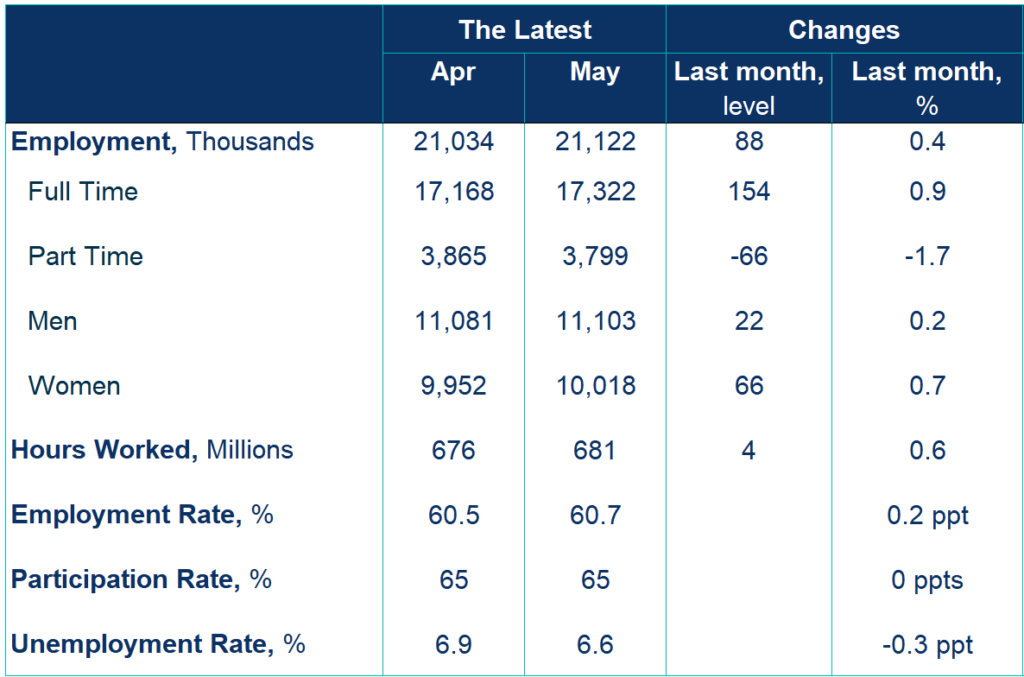
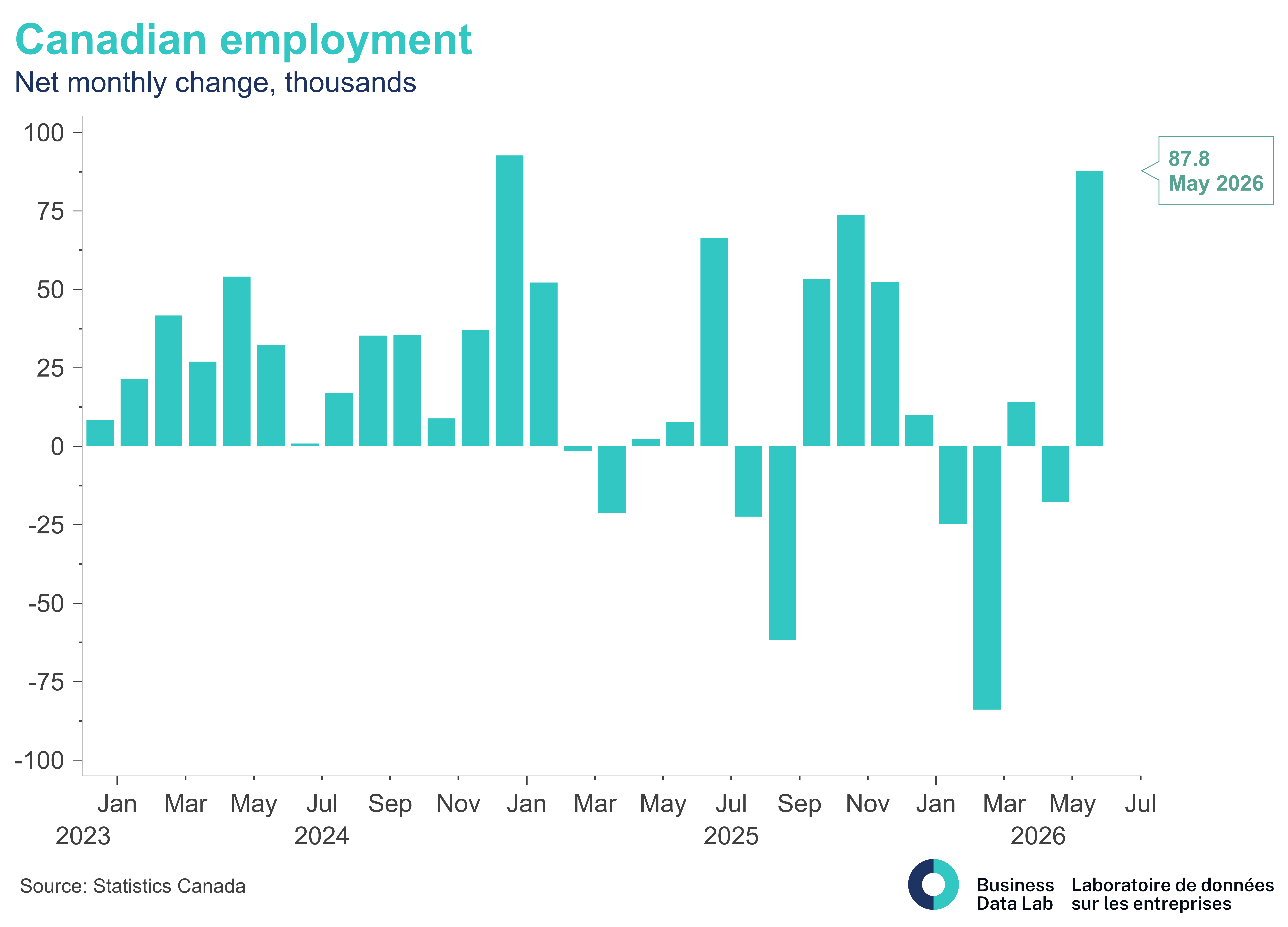
After months of labour market weakness, Canada added 88,000 jobs in May, clawing back nearly 80% of the employment lost over the first four months of the year. The gains were broad based: youth unemployment surged by 22,000, driving the youth unemployment rate down nearly a full percentage point to 13.4%, while core-aged workers also posted solid gains. Critically, virtually all of the gain was in full-time work, spanning both goods-producing and services sector.
However, this month’s positive uptick in the labour market, with -0.1% growth in GDP in the backdrop, once again puts the Bank in a tricky balancing act. Without any clear signals, we expect the Bank to stay on the sidelines and hold its policy rate for the fifth consecutive time.
Key Takeaways
- Employment Levels: In May, Canada experienced its first month of most significant employment gain since the beginning of 2026, added over 88,000 new workers to the economy, clawing back nearly 80% of the net employment lost since January 2026. Employment rate rose 0.2 percentage points month-over-month to 60.7% in May — the first increase since November 2025.
- Unemployment and Participation Rates: Though participation rate remained unchanged at 65%, the unemployment rate fell 0.3 percentage points month-over-month to 6.6%, retreating from April’s recent high of 6.9%. Importantly, the decline was driven by real, absolute gains in employment rather than a shrinking labour force.
- Demographics and Job Types: After months of weak hiring, May recorded its strongest full-time employment gain since November 2025, adding 154,000 full-time jobs, fully offsetting the 156,000 full-time positions lost between January and April. Part-time employment declined by 66,000 in the same month. Both youth and core-aged workers shared the gains, with unemployment rates falling 0.9 and 0.4 percentage points to 13.4% and 5.6% respectively, month-over-month. Youth accounted for roughly 25% of total employment gains, with the remainder split between core-aged men and women, with marginally more women added to the employed pool.
- Sectoral Breakdown: Employment gains were broad-based, spanning both goods-producing and services industries. Construction led all sectors with +27,000 jobs, followed by information, culture and recreation (+19,000), transportation and warehousing (+19,000), and accommodation and food services (+17,000). Manufacturing also added 15,000 jobs, though the sector remains under pressure from U.S. tariff uncertainty. The only significant drag came from wholesale and retail trade, which shed 35,000 jobs.
- Provincial Trends: Provincial gains were also broad-based, with 7 out of 10 provinces recording a decline or no change in their unemployment rates. Ontario led all provinces, adding 42,000 jobs with its unemployment rate falling to 7.0%, lowest since September 2024. Alberta and Quebec rounded out the gains at +14,000 and +13,000 respectively, while Saskatchewan was the only province to record a notable employment decline (-6,100).
Tables
Other Blogs

Where Canada’s defence debate goes next

Recession or Resilience? An unexpected first-quarter GDP contraction points to an uphill battle.

Pivot or Peril: Are Canadian Cities Diversifying or Doubling Down on America?

Retail sales defy expectations, but spending may be running out of gas.

Inflation becoming more of an isolated energy story, for now : April 2026 CPI

Narrow Strait, Wide Impact: How a Global Shock Reaches Canada

Canada Needs More Than “Steady”: Key Findings from Business Insights Quarterly (Q1 2026)

Falling employment masks a deeper worry, with full-time jobs being replaced by part-time work: Labour Force Survey April 2025