







Falling employment masks a deeper worry, with full-time jobs being replaced by part-time work
Labour Force Survey April 2025

Anupriya Gangopadhyay
Share:




The dip in today’s job numbers is concerning. Despite firmer real GDP growth, promising signs of trade diversification beyond the U.S. market, and the Bank holding its policy rate, labour market outcomes remain underwhelming.
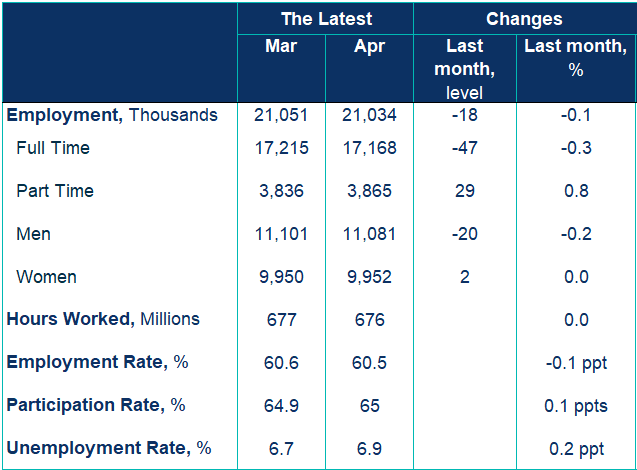
Employment rates slipped and unemployment edged up to 6.9%, not because of rising layoffs but because more people are entering the search. Year to date, 112,000 jobs have been lost, with full-time losses outpacing part-time gains. Seeing part-time work now partially backfilling full-time positions should give us pause. This full-time displacement trend is something we will continue to watch closely to see if it becomes structural, given it’s not the signal of resilience that businesses and economic observers are looking for.
Key Takeaways
- Employment Levels: Employment was essentially flat in April, slipping by 18,000 (-0.1%), marking the second consecutive month of stagnation following February’s sharper 84,000 drop. Year-to-date, the economy has shed a net 112,000 jobs (-0.5%) since January. The employment rate fell to 60.5%, matching the August 2025 low and sitting 0.3 percentage points below its year-ago level. On a year-over-year basis, employment is up a modest 67,000 (+0.3%).
- Unemployment and Participation Rates: The unemployment rate rose 0.2 percentage points to 6.9%, driven not by layoffs, but by 51,000 more people actively searching for work. The rate has climbed 0.4 points since January, though it remains below the mid-2025 peak of 7.1%. Long-term unemployment (27+ weeks) sits at 22.5%, well above the 2017–2019 average of 17.1%, signaling an uptick in the time spent searching for a new job. Participation ticked up to 65.0%, though the rate is still down 0.3 points year over year, partly reflecting aging population.
- Demographics and Job Types: Full-time work fell by 47,000 in April, while part-time rose by 29,000. Year-to-date, 111,000 full-time positions have been lost — nearly the entirety of the net 112,000 decline. Youth unemployment jumped 0.5 points to 14.3%, with the youth employment rate at just 53.9%. Core-aged men saw unemployment rise 0.3 points to 6.1%; core-aged women held steady at 5.9%. Workers 55+ were the relative bright spot, with unemployment unchanged at 4.9%.
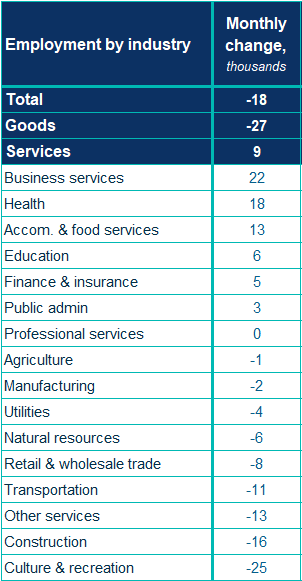
- Sectoral Breakdown: Monthly losses were concentrated in information, culture and recreation (-25,000), construction (-16,000), and other services (-13,000). Gains came from business and support services (+22,000), health care and social assistance (+18,000), and accommodation and food services (+13,000). The year-over-year picture is dominated by health care, which added 119,000 jobs (+4.1%), other sectors were flat or slightly negative on a 12-month basis.
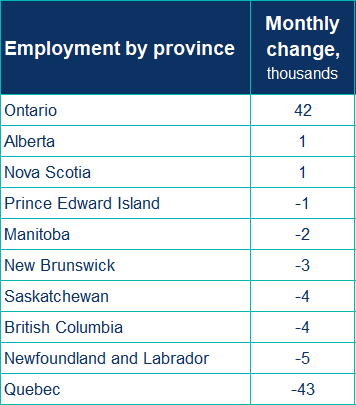
- Provincial Trends: Quebec experienced significant drop in employment, by 43,000 in April alone, and the province has lost a net 91,000 jobs since January (-1.9%), heavily concentrated in Montréal, where employment fell 56,000 (-2.3%) over the period and unemployment hit 7.7% , its highest since July 2016 outside the pandemic years. Quebec’s unemployment rate surged 0.8 points to 6.2%. Ontario added 42,000 jobs, partially recovering from January’s 67,000 loss; its unemployment rate edged down to 7.5%. Employment declined marginally in Newfoundland and Labrador (-5,200), Saskatchewan (-4,000), and New Brunswick (-2,700).
Tables
Other Blogs

Pivot or Peril: Are Canadian Cities Diversifying or Doubling Down on America?

Retail sales defy expectations, but spending may be running out of gas.

Inflation becoming more of an isolated energy story, for now : April 2026 CPI

Narrow Strait, Wide Impact: How a Global Shock Reaches Canada

Canada Needs More Than “Steady”: Key Findings from Business Insights Quarterly (Q1 2026)

Price-Driven Surge Pushes Canada Back into Surplus: Merchandise Trade March 2026

Canada’s economy on pace to rebound in the first quarter

The Bank of Canada sees current interest rate “appropriate” despite energy shock.