







Sticky hiring, but wage growth at its highest since 2024
Labour Force Survey March 2025

Anupriya Gangopadhyay
Share:




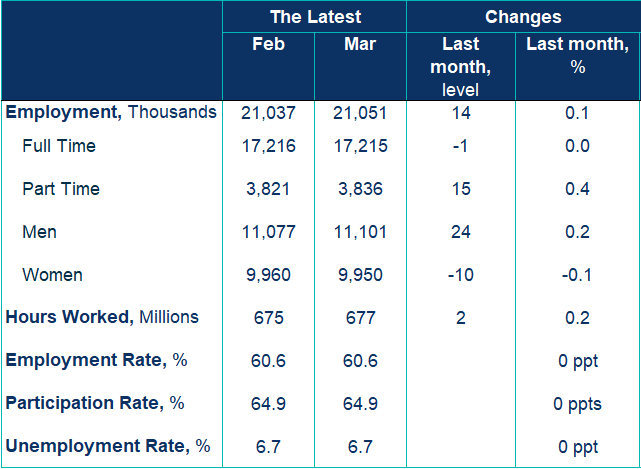
Canadian employers are once again adopting a wait-and-see approach – being cautious not only in hiring but also in layoffs – a strategy that has been used at multiple points over the past year. Overall, in March 2026, employment levels were largely unchanged, and the unemployment rate held steady, underscoring a labour market that is stable but subdued. The only clear bright spot is wage growth, which recorded its strongest pace since 2024.
While employers’ prudence in hiring decisions is helping maintain labour market stability, heightened global uncertainty continues to weigh on momentum. On this backdrop, we expect the Bank to hold its policy rate once again, for a fourth consecutive time, until clearer economic signals begin to emerge.
Key Takeaways
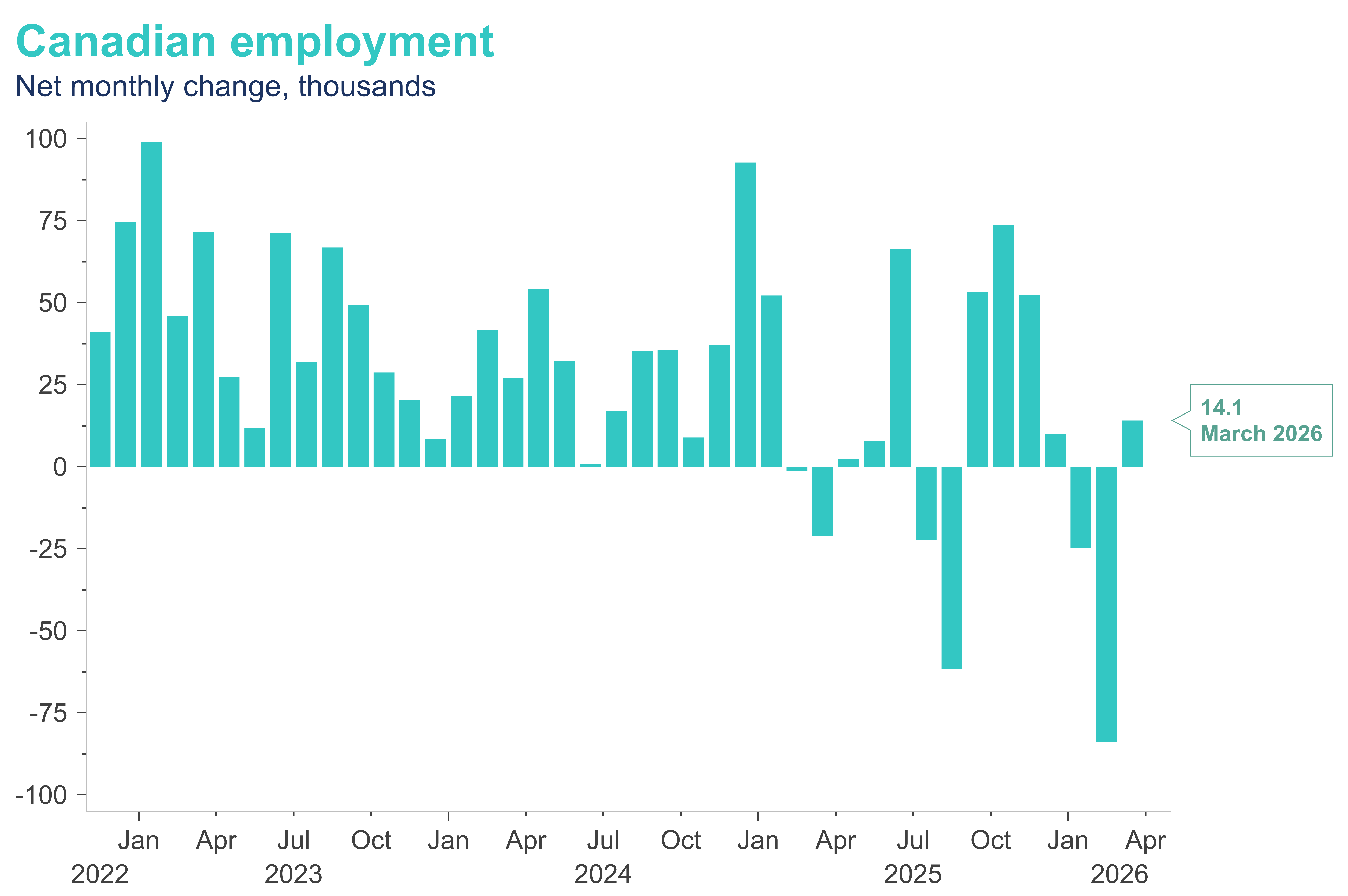
- Employment Levels: Employment rose marginally by 14,000 in March, after cumulative losses of 109,000 in the first two months of the year, indicating a pause, not reversal, in labour market softening. This suggests employers are holding back on hiring while also avoiding significant layoffs. After a year of tariffs on Canadian goods and services, overall employment increased modestly y/y, by 87,000 (+0.4%), indicating labour market resilience to unprecedented economic shocks.
- Unemployment and Participation Rates: Labour market slack remained relatively stable, with unemployment rate holding steady at 6.7% in March, unchanged from February and below the 7.1% peak observed in fall 2025. The stability in unemployment reflects subdued hiring rather than rising layoffs, as labour market adjusts gradually. Similarly, the participation rate showed no change from its February level, indicating limited movement in or out of the labour force.
- Demographics and Job Types: Labour market outcome remained stable across various demographic groups, with little to no change in the unemployment rate across men and women across various age groups. However, the recent employments gains has been entirely in part-time jobs and among the youths, suggesting growing reliance on flexible and part-time work arrangements.
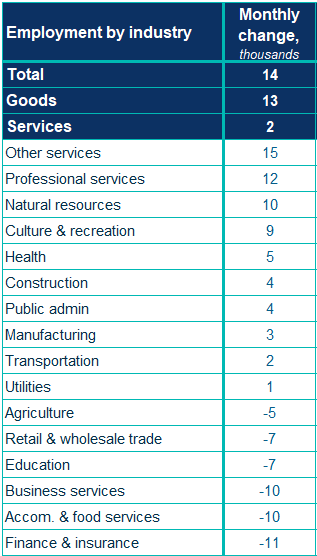
- Sectoral Breakdown: Sectoral trends highlight increased part-time hiring in service sectors to meet temporary demands. Employment gains were concentrated in “other services” (+15,000), professional services (+12,000) and natural resources (+10,000).
- Provincial Trends: The regional labour market performance remains mixed, underscoring uneven economic performance across province. Employment declined notably in British Columbia (-19,000; -0.7%), while gains were recorded amongst the prairie provinces (Manitoba: +11,000, Alberta: +6,000 and Saskatchewan: +6,000).
Tables
Charts
Other Blogs

Falling employment masks a deeper worry, with full-time jobs being replaced by part-time work: Labour Force Survey April 2025

Price-Driven Surge Pushes Canada Back into Surplus: Merchandise Trade March 2026

Canada’s economy on pace to rebound in the first quarter

The Bank of Canada sees current interest rate “appropriate” despite energy shock.

Use it while you can: The federal government spends its growth-driven fiscal windfall

A Solid Start, but Signs of Fatigue Emerging: Retail Sales February 2026

Inflation rises on energy shock, but underlying price pressures muted.

Volatile Imports Drive Wider Deficit Despite Export Rebound: Merchandise Trade February 2026