



Use it while you can: The federal government spends its growth-driven fiscal windfall
Spring Economic Update 2026

Andrew DiCapua
Share:




The federal government presented its Spring Economic Update with improved fiscal and economic conditions and spent most of its available fiscal room, rather than setting any aside as a buffer.
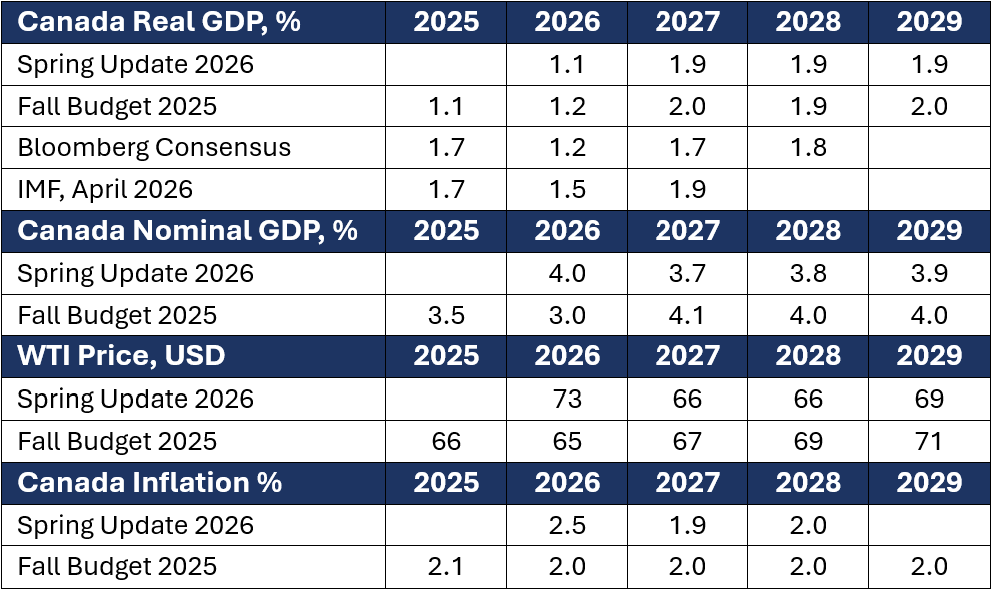
Prime Minister Carney and Finance Minister Champagne were given a fiscal gift. Since Budget 2025, stronger economic data freed up $60.3 billion in new fiscal room from fiscal year 2026–30 (about $10.7 billion annually), but this gain was mostly absorbed by new spending. Higher nominal GDP growth (4.3% in 2025 and 4% in 2026, both above Budget 2025), stronger oil prices, and tariff-related revenues have all lifted the fiscal outlook. Import duties are expected to bring in $10.1 billion in FY2026, with revenues from U.S. countermeasures and China surtaxes. The outlook incorporates both an upside scenario driven by stronger investment and a downside scenario tied to global disruptions with the baseline growth outlook reasonably conservative. Finance estimates that if oil prices average $80 USD in 2026 (above the $73 baseline assumption) nominal GDP would be $17 billion higher.
The Spring Economic Update introduces $37.5 billion in new measures over six years, including $17 billion that was added since Budget 2025, bringing total net new spending to $54.5 billion. The bulk of this is concentrated in the section titled “Benefitting Canadians: A Canada for All,” which focuses on improving affordability and supporting workers and younger Canadians. Most of the big measures were previously announced like the groceries benefit, gas excise tax removal and housing supply funding to provinces. The update also includes $103.8 million over five years (plus ongoing funding) to establish a Defence Investment Agency and $2 billion over three years for defence and security priorities. However, this does little to address the $150 billion gap identified by the Parliamentary Budget Office in reaching its 2035 defence spending target of 3.5% of GDP.
The update also provided new information on The Canada Strong Fund which is being positioned as a new financial product offered by the federal government to support strategic domestic projects that “will drive the transformation of Canada economy and create wealth for Canadians, while giving Canadians the opportunity to share directly in the financial returns.” The source of the initial $25 billion in seed capital remains unclear, with only $6 million accounted for to set up a transition office.
The government is still on track to meet its fiscal anchors of balancing the operating budget by FY2029 and ensuring a declining deficit-to-GDP ratio, reinforcing a near-term commitment to fiscal discipline. The FY2026 deficit is now projected at $67 billion (2.1% of GDP), down from $78.3 billion in Budget 2025 and $11.5 billion lower overall. While deficits are expected to decline gradually to $53 billion by FY2031, the pace of improvement remains limited over the forecast horizon. The coveted debt-to-GDP anchor has not been reinstated, despite recommendations from the IMF in their recent Canada review. The ratio is about a percent lower relative to Budget 2025, it is projected to edge up from 41.1% in FY26 to 42% by FY31, pointing to lingering structural pressures.
Program expenses are down $7.6 billion in FY2026, but rise over time, ending the forecast horizon nearly $6 billion higher by FY2030 compared to Budget 2025. With provinces facing more challenging fiscal conditions, defence spending pressures building, and downside risks to the outlook, any gains from higher oil prices or stronger GDP could prove temporary. The government also committed to ongoing horizontal spending reviews to focus on spending across departments. To kick this off, they’ve recently initiated a federal contracts review and committed to reducing external consulting and management spending by 20% over three years, generating savings of $450 million in FY2028 and $900 million annually thereafter.
Overall, Canada’s economic resilience and improved fiscal position point to a relatively stable outlook for public finances, even with uncertainty ahead. The investments in new initiatives are focused on building people and capacity. That said, near-term pressures haven’t gone away, and the broader economy is still facing some significant structural challenges. Productivity and competitiveness need to stay front and centre. While business sentiment has started to improve, the Spring Update is more incremental. The government is encouraging Canadians to invest more, but that only works if those investments continue to deliver strong returns.
Economic Projections
Charts
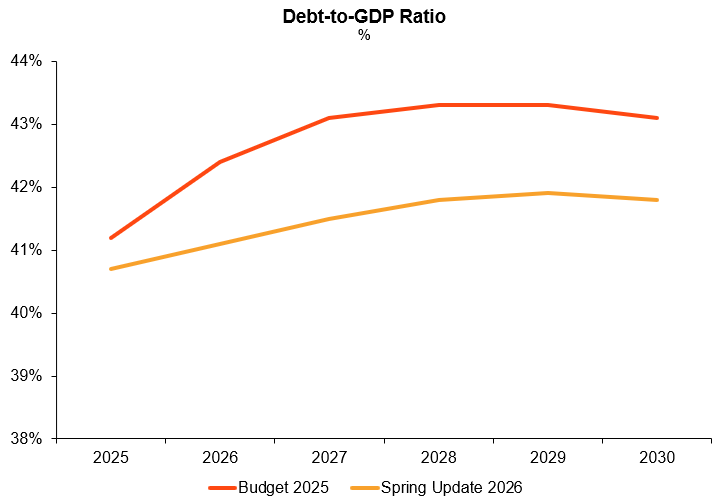
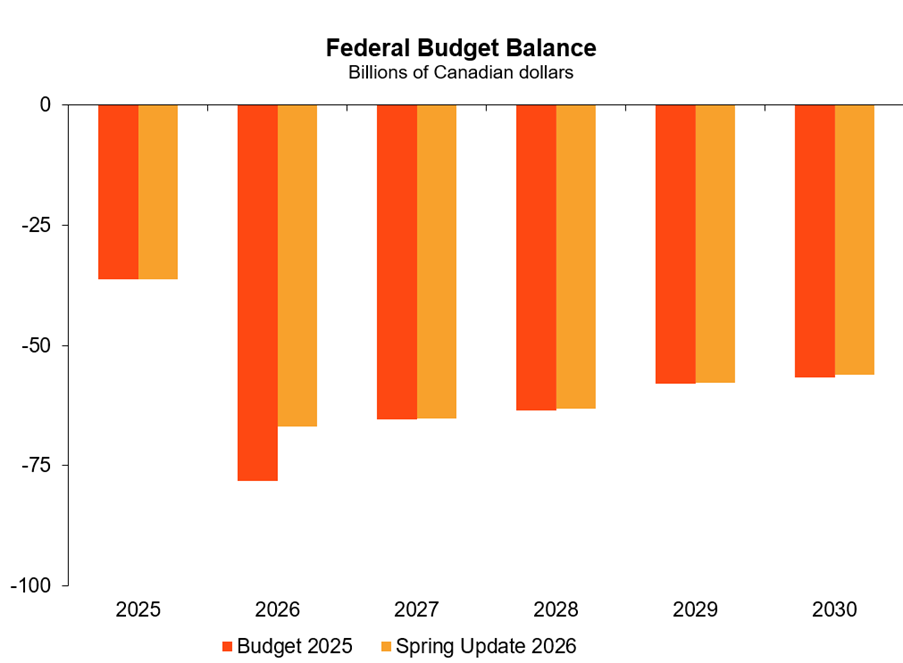
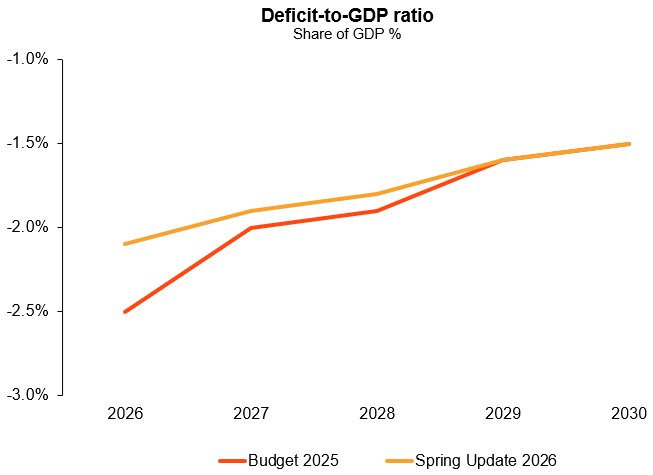
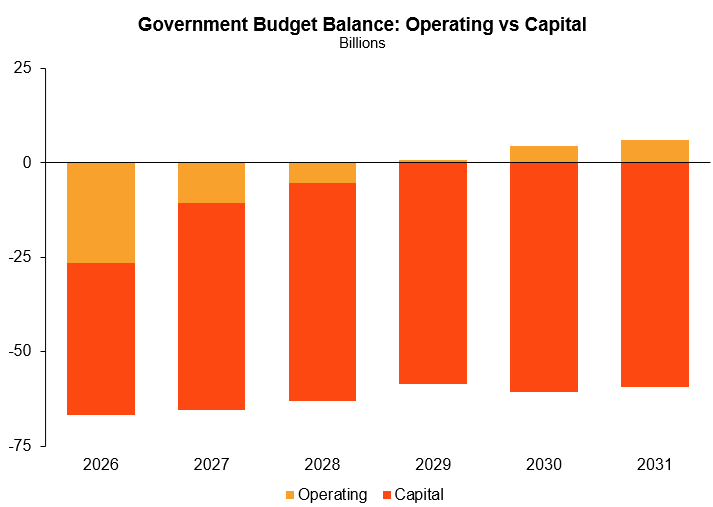
Sources: Business Data Lab, Department of Finance Canada.
Other Blogs

Canada’s economy starts the second quarter with firmer footing

The Inflation Gap Widens as Price Pressures Spread Beyond Energy: May 2026 CPI

Consumers Keep Spending, but the Menu Is Narrowing

The Bank of Canada faces a dilemma as it extends its holding pattern

Canada’s Trade Story Finds New Supporting Cast: Merchandise Trade April 2026

It is green across the board for May’s labour market: Labour Force Survey May 2026

Where Canada’s defence debate goes next
Recession or Resilience? An unexpected first-quarter GDP contraction points to an uphill battle.