



Auto Shutdowns Reverse Canada’s Export Momentum
Merchandise Trade January 2026

Jasleen Trehan
Share:




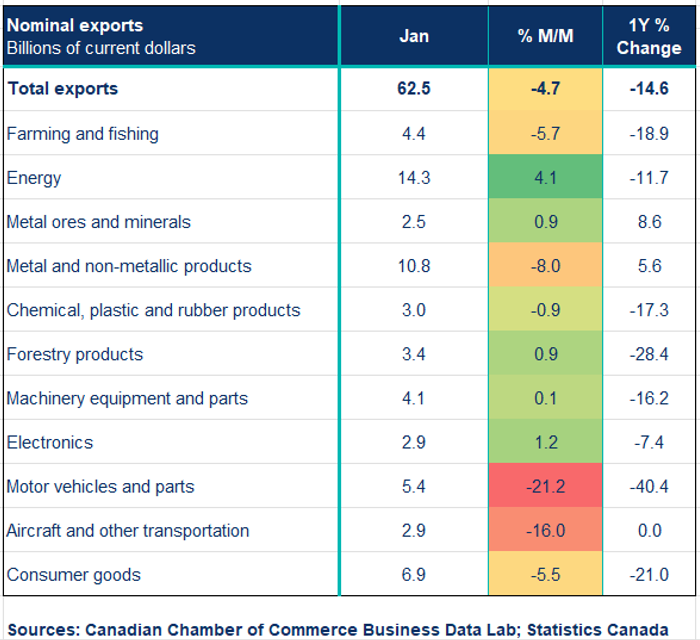
Canada’s trade sector got off to a weak start to the year, with merchandise exports falling 4.7% and the trade deficit widening to $3.6 billion from $1.3 billion in December. Shipments declined to both the U.S. and non—U.S. markets, with exports to the U.S. down 3.8% and exports to other countries falling 6.5%. Sectors that drove momentum in December – including autos and gold exports – saw sharp pullbacks, with motor vehicle and parts exports plunging more than 21% amid production shutdowns. If export volumes remain subdued, trade could drag first—quarter GDP growth further down.
Headline
Canada’s merchandise exports fell 4.7% to $62.5 billion in January, while imports declined 1.1%, widening the merchandise trade deficit to $3.6 billion from $1.3 billion in December. In real (volume) terms, exports declined 5.8% while imports fell 2.2%, suggesting weaker trade flows at the start of the year. The decline follows a stronger finish to 2025, when exports rose 2.6% in December, supported by surges in metals — primarily gold and aircraft shipments. Much of the volatility reflects Canada’s concentrated export mix, where swings in sectors such as autos, aircraft and precious metals continue to disproportionately shape monthly trade outcomes.
Key Takeaways
- Export declines were recorded in 6 of 11 product categories, underscoring the breadth of the January pullback. Merchandise exports declined 4.7%, reversing December’s gains, with the largest drag coming from motor vehicles and parts, as exports fell 21.2% to $5.4 billion — the lowest level since September 2021, largely due to prolonged seasonal production shutdowns linked to model changeovers in Canadian auto plants. Additional declines in metal and non—metallic mineral products (-8.0%), driven by lower unwrought gold shipments to the United Kingdom, and aircraft exports (-16.0%) after a strong December also contributed to the overall drop. Energy exports rose 4.1%, led by a 23.7% surge in natural gas exports amid extreme winter conditions in parts of the United States.
- Imports edged down 1.1%, mainly reflecting lower motor vehicles and parts imports (-4.5%), coinciding with reduced domestic auto production, and weaker electronic and electrical equipment imports (-3.6%), driven by lower smartphone shipments. Partially offsetting the decline were higher industrial machinery imports (+3.4%), linked to equipment shipments for LNG infrastructure projects in British Columbia.
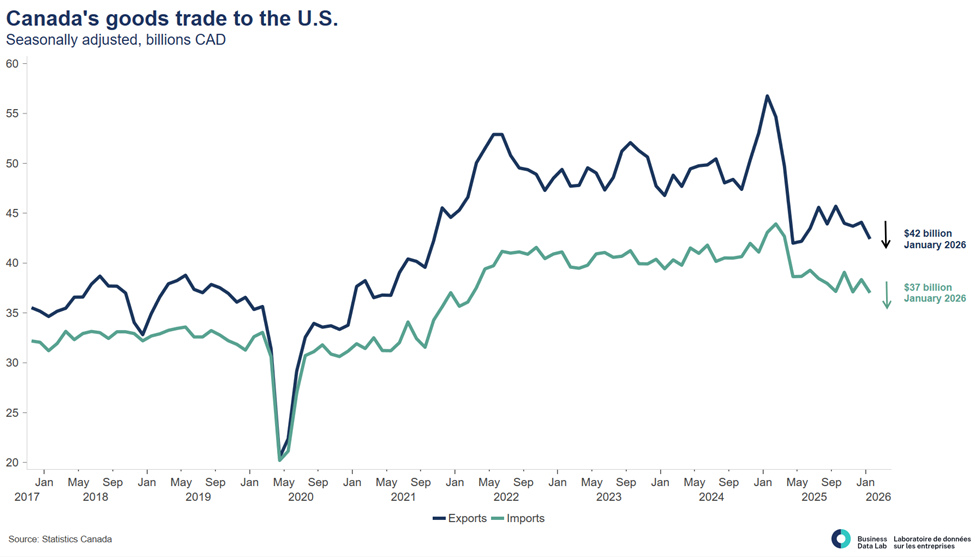
- Exports to the United States fell 3.8%, reflecting weaker shipments in sectors such as aircraft and autos, while exports to non—U.S. markets declined 6.5%, largely due to lower gold shipments to the United Kingdom after December’s surge. Canada’s trade deficit with non—U.S. partners widened to $9.0 billion from $7.0 billion in December, while the bilateral surplus with the United States narrowed slightly.
- Service exports declined 1.1% to $19.8 billion, while service imports rose 1.8% to $19.9 billion, shifting Canada’s services balance from a surplus to a small deficit. When goods and services are combined, Canada’s trade deficit expanded to $3.8 billion from $860 million in December.
- January’s pullback largely reflects temporary factors, including auto production shutdowns and volatile commodity shipments such as gold. However, the release highlights how Canada’s export performance remains sensitive to swings in a few key sectors, meaning sustained export momentum will depend on a rebound in manufacturing output.
Implications
- The sharp drop in exports reversed December’s gains, suggesting net trade is unlikely to support growth early in 2026.
- Autos, gold, and aircraft remain key swing factors in Canada’s export data, meaning monthly trade balances can shift significantly based on production schedules and commodity shipments.
- Stronger natural gas exports partially offset broader export weakness, underscoring the continued importance of energy demand — particularly from the United States – in supporting Canada’s trade balance.
- If export volumes do not rebound following January’s auto production shutdowns, trade is likely to act as a headwind for first—quarter GDP growth, rather than the support seen late in 2025.
Sources: Statistics Canada; Canadian Chamber of Commerce Business Data Lab
Other Blogs

Consumers Return to the Checkout with Broader Spending

Inflation cools ahead of the summer months

The Bank of Canada gains more confidence in growth prospects despite inflation risk

Canada’s labour market finally caught a bit of a break in June: Labour Force Survey May 2026

Record Exports Signal a Broader Trade Story: Merchandise Trade May 2026

Canada’s economy starts the second quarter with firmer footing

The Inflation Gap Widens as Price Pressures Spread Beyond Energy: May 2026 CPI

Consumers Keep Spending, but the Menu Is Narrowing