







Gold Payback and Auto Tariffs Push Canada Back into Deficit
Merchandise Trade November 2025

Jasleen Trehan
Share:




Canada’s trade position weakened in November as a pullback in gold exports and a tariff-driven drop in motor vehicle shipments more than offset gains elsewhere. Imports were essentially flat, but exports fell enough to widen the deficit underscoring an external sector that’s acting as a drag on growth. Beneath the headline, the message is clear: this was a concentrated, policy- and commodity-driven setback, not a broad-based collapse in demand consistent with an economy that is cooling, not stalling, as 2025 ends.
Headline
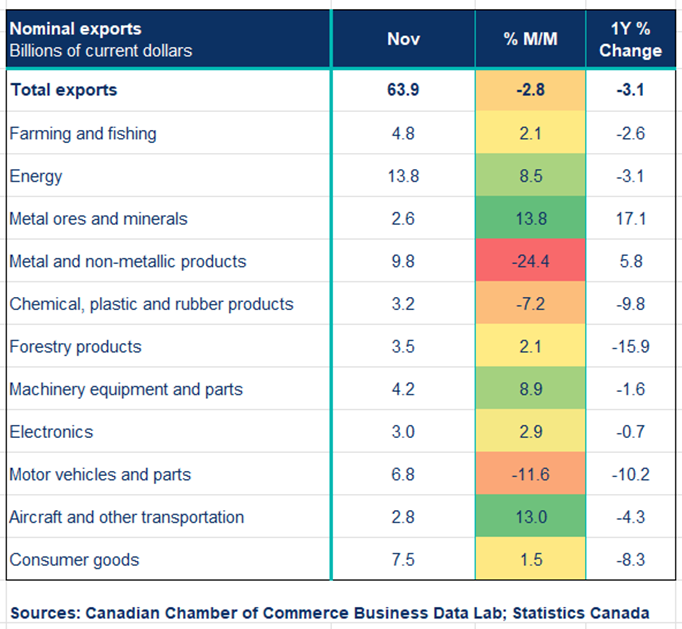
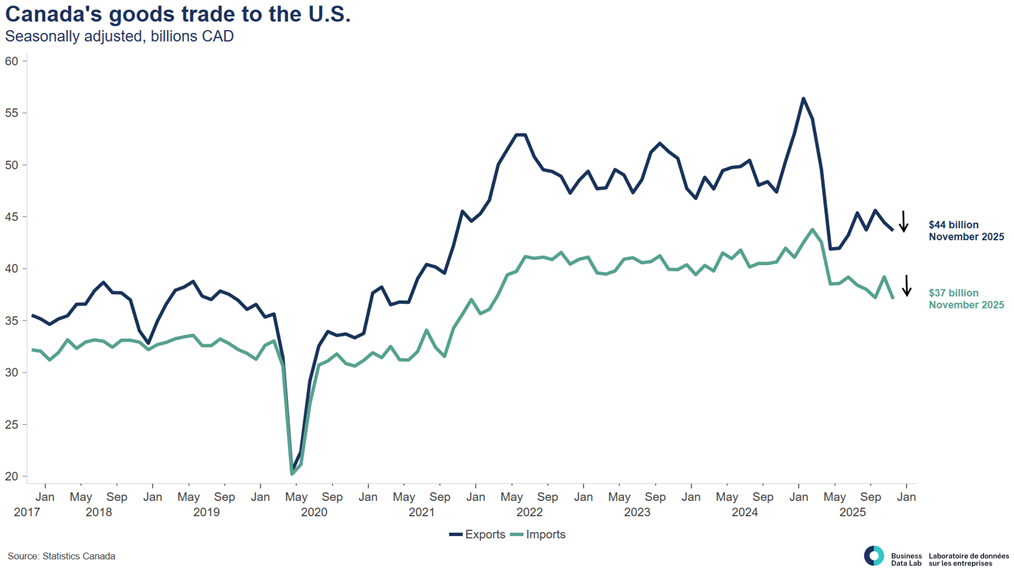
In November, merchandise exports fell 2.8% to $63.9 billion, while imports edged down 0.1% to $66.1 billion. As a result, Canada’s goods trade deficit widened to $2.2 billion, from a $395 million deficit in October. Exports to the United States declined 1.8% to $43.7 billion, while imports from the U.S. fell more sharply (–5.4% to $37.1 billion), widening Canada’s bilateral surplus to $6.6 billion. In contrast, exports to non-U.S. markets fell 4.9%, while imports from those countries rose 7.8%, pushing the non-U.S. trade deficit to $8.8 billion. Including services, Canada’s total trade balance shifted from a small $27 million surplus in October to a $2.2 billion deficit in November.
Key Takeaways
- Exports drove the deterioration, but the weakness was highly concentrated. Merchandise exports fell 2.8% ($1.8B) in November, largely reflecting a sharp pullback in gold exports, which declined 24.4% after surging by $4.7B over September and October, and an 11.6% drop in motor vehicle exports following new U.S. tariffs on heavy trucks and buses. Excluding metal and non-metallic mineral products, exports rose 2.5%, underscoring how commodity volatility is distorting the headlines.
- Imports were stable, signaling resilient domestic demand. Import values were essentially flat (–0.1%), even as real import volumes rose 0.9%, suggesting domestic demand is moderating but not contracting. Lower energy imports weighed on the headline, while consumer goods imports rose 6.2%, led by pharmaceuticals and apparel.
- Energy exports cushioned, but did not reverse, the decline. Energy exports increased 8.5%, driven by higher crude oil and bitumen volumes after temporary U.S. refinery disruptions constrained shipments in October. The rebound helped offset losses elsewhere but largely reflects normalization rather than a renewed uptrend.
- Trade imbalances widened outside the United States. Canada’s trade surplus with the U.S. widened to $6.6B, mainly because imports from the U.S. fell 5.4%. In contrast, the non-U.S. trade deficit widened to $8.8B, as exports fell 4.9% while imports rose 7.8%, highlighting that diversification remains import-led rather than export-driven.
- November’s trade setback reflects gold volatility and tariff-hit autos, not a collapse in demand. With exports soft and imports holding up, net trade is likely to remain a drag on growth as the Canadian economy cools into year-end.
- Including services, Canada’s total trade balance shifted from a $27 million surplus in October to a $2.2 billion deficit in November, reinforcing the view that external demand and policy-related disruptions are weighing on growth momentum.
Implications
- Volatility, not broad weakness, is driving the trade setback. Gold normalization and tariff-related auto declines mean headline weakness overstates underlying demand conditions
- Auto trade poses a persistent downside risk. New U.S. tariffs suggest vehicle export weakness could extend into December and early 2026, weighing on manufacturing momentum.
- Net trade will remain a drag on near-term growth. With exports soft and imports holding up, trade is unlikely to contribute meaningfully to Q4 GDP.
- External imbalances outside the U.S. are widening. Strong non-U.S. imports alongside weaker exports imply diversification efforts remain skewed toward sourcing rather than sales.
Sources: Statistics Canada; Canadian Chamber of Commerce Business Data Lab
Other Blogs

Auto Shutdowns Reverse Canada’s Export Momentum: Merchandise Trade January 2026

Inventory drawdown causes GDP to knee jerk into contraction despite improving fundamentals.

Momentum stalls as consumer shifts into a lower gear: Retail Sales December 2025

Diversification Gains Traction as Exports Close the Year Stronger: Merchandise Trade December 2025

6 Predictions for the Canadian Economy in 2026

Conflicting signals as both unemployment and employment rate declines: Labour Force Survey December 2025

Canada’s Productivity Gap Is a Vulnerability We Must Fix

Weak economic momentum could spell fourth quarter contraction.