







Labour market softens as job losses mount and youth unemployment climbs
Labour Force Survey February 2025
March 13, 2026
3 min read

Anupriya Gangopadhyay
Share:




Canada’s labour market continued to cool in February, with the unemployment rate rising to 6.7% after a slight dip in January. In the first two months of 2026 alone, the economy has shed more than 100,000 jobs, with February’s losses concentrated in full-time positions and among youth, signalling weak momentum in hiring. Public sector layoffs, driven in part by the federal government’s workforce reduction plans, have reached their highest level since September 2025
Against this backdrop of cautious hiring and broader economic uncertainty, we expect the Bank of Canada to hold its policy rate steady for a third consecutive decision at its upcoming announcement.
KEY TAKEAWAYS
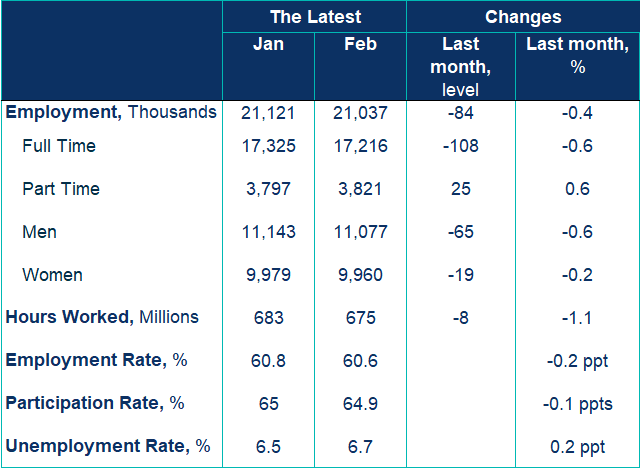
- Employment Levels: Canada’s labour market weakened notably in February, with employment declining by 84,000 jobs, on top of the 25,000 lost in January 2026. On a month-over-month basis, employment level fell by 0.4%, while the employment rate declined by 0.2 percentage points to 60.6%, reflecting a modest contraction in the total labour force.
- Unemployment and Participation Rates: The unemployment rate rose to 6.7% in February from 6.6% in January, reversing the temporary improvement seen at the start of the year and signaling renewed slack in the labour market. Meanwhile, the participation rate recorded little change in February 2026, suggesting that labour supply conditions remained broadly unchanged.
- Demographics and Job Types: Job losses were particularly pronounced among youth (aged 15–24), with employment declining sharply by 47,000, pushing the youth unemployment rate up to 14.1%. Core-aged men were the second most affected group, losing 41,000 jobs, with their unemployment rate rising by 0.3 percentage points month-over-month to 5.7%. In contrast, recent trends suggest that senior workers (aged 55 and above) have been relatively less affected by ongoing labour market adjustments, with their unemployment rate declining by 0.3 percentage points y/y to 4.9%.
- Sectoral Breakdown: Employment declines were observed across both goods-producing and service-producing industries, with job losses in the service sector roughly twice those recorded in goods-producing industries. The downturn was broad-based across most sectors, led by declines in wholesale and retail trade (-18,000), pointing to softer consumer demand and tightening business conditions.
- Provincial Trends: Employment declines were recorded across several provinces, with Quebec (-57,000) and British Columbia (-20,000) accounting for a significant share of the losses. For Quebec, this marked the first notable employment decline since January 2022. The province’s unemployment rate has risen by 1.4 percentage points over the past three months, from a recent low of 4.8% recorded in November 2025.
TABLES

CHARTS

Other Blogs

Volatile Imports Drive Wider Deficit Despite Export Rebound: Merchandise Trade February 2026

January 2026 GDP: Canada’s economy kicks off 2026 on decent footing

Strong Start to the Year, but Underlying Momentum Remains Fragile: Retail Sales January 2026
Bank of Canada holds interest rates on cloudy conditions downplaying oil price risk to inflation
The dip before the spike, as base effects bring inflation below 2%
Auto Shutdowns Reverse Canada’s Export Momentum: Merchandise Trade January 2026
Inventory drawdown causes GDP to knee jerk into contraction despite improving fundamentals.

Momentum stalls as consumer shifts into a lower gear: Retail Sales December 2025