







Conflicting singals as both unemployment and employment rate declines
Labour Force Survey December 2025

Anupriya Gangopadhyay
Share:




While it is positive news that the unemployment rate has edged down from its peak in mid-2025 to 6.5% in January 2026, the underlying drivers of this decline are less encouraging. The latest release suggests that the decrease is largely stemming from a shrinking working-age population, primarily driven by stricter immigration policies, rather than an improvement in labour market conditions. Moreover, even after nine months of U.S. tariffs, employment in the manufacturing sector continues to slip downwards.
Although recent developments indicate that Canada is actively diversifying its trading partners—as discussed in our latest trade commentary—the economic and employment impacts of these efforts have yet to materialize.
KEY TAKEAWAYS
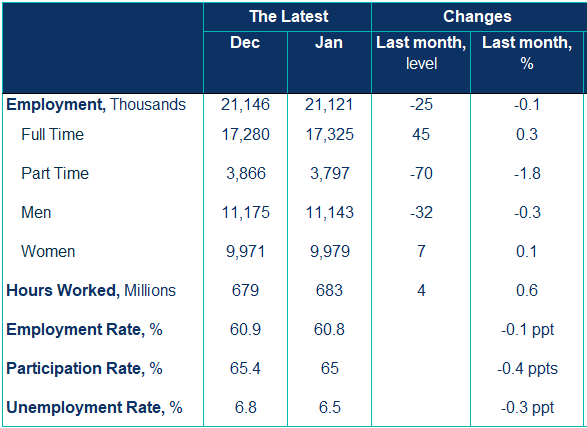
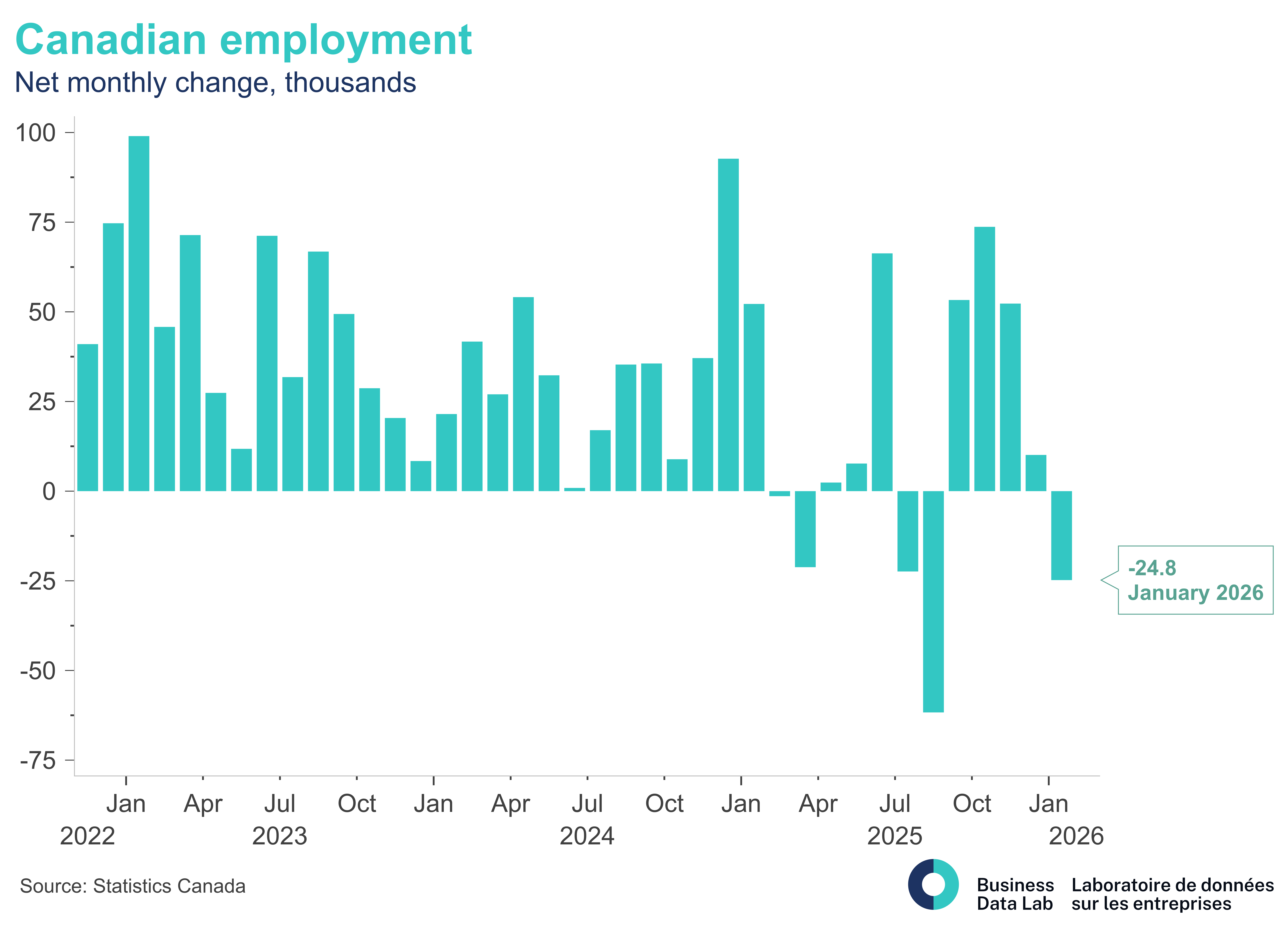
- Employment Levels: After ending 2025 on a positive note, employment levels declined by 25,000 at the start of 2026, while employment rate fell by 0.1 percentage point. Although month-over-month employment decreased by 0.5%, total employment remained higher year-over-year, posting a 0.4% increase.
- Unemployment and Participation Rates: The unemployment rate has declined by 0.6 percentage points from its mid-2025 peak of 7.1% to 6.5%, offering some relief. However, the driver of the decline is a shrinking labour force, as a result of stricter immigration policies, rather than improving labour market conditions. With fewer job openings and fewer people actively searching for jobs, the participation rate also fell by 0.4 percentage points to 65.5%, from the previous month.
- Demographics and Job Types: Unemployment was down across most demographic groups, largely reflecting fall in number of job searchers. Among young and core-aged workers, unemployment rate fell by 0.5 percentage points to 12.8% and 5.5%, respectively. Employment level was unchanged for core-aged men, m/m, but for core-aged women, employment was down by 0.4 percentage points. In January 2026, the net change in employment was driven by sharp drop in part-time employment (-70,000), which was partially offset by gains in full-time employment (+45,000).
- Sectoral Breakdown: Amidst renewed efforts to diversify trade partners, employment in manufacturing sector continues to slip; employment fell by 28,000 from the previous month and down by 51,000 (-2.7%) from January 2025. Amid structural and technological pressure, including increased adoption of AI, employment fell in the service sector too. Education services lost 24,000 (-1.5% m/m) jobs, followed by professional services (-11,000). In contrast, employment gains were observed in industries requiring greater human interaction, such as information and cultural industries (+17,000) and healthcare (+8,000).
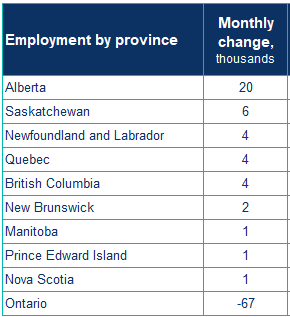
- Provincial Trends: Employment losses in Ontario (-67,000) more than offset gains recorded in other provinces, led by Alberta (+20,000) and Saskatchewan (+6,000). Employment changes in the remaining provinces were minimal.
TABLES
CHARTS
Other Blogs

Strong Start to the Year, but Underlying Momentum Remains Fragile: Retail Sales January 2026

Bank of Canada holds interest rates on cloudy conditions downplaying oil price risk to inflation
The dip before the spike, as base effects bring inflation below 2%

Labour market softens as job losses mount and youth unemployment climbs: Labour Force Survey February 2025

Auto Shutdowns Reverse Canada’s Export Momentum: Merchandise Trade January 2026
Inventory drawdown causes GDP to knee jerk into contraction despite improving fundamentals.

Momentum stalls as consumer shifts into a lower gear: Retail Sales December 2025

Diversification Gains Traction as Exports Close the Year Stronger: Merchandise Trade December 2025