







6 Predictions for Canada's Economy in 2026

Andrew DiCapua
Share:




A new year brings a new set of challenges and opportunities for Canada’s economy — and a fresh round of predictions.
Despite some encouraging economic data late last fall, Canada entered 2026 with a fragile growth outlook, lingering uncertainty and major external risks. Cautious optimism has survived — so far — but a lot needs to go right this year.
Based on these factors, here’s what we’re predicting for 2026:
1. Canada’s trade share with the U.S. hits record lows
The U.S. dependency paradox
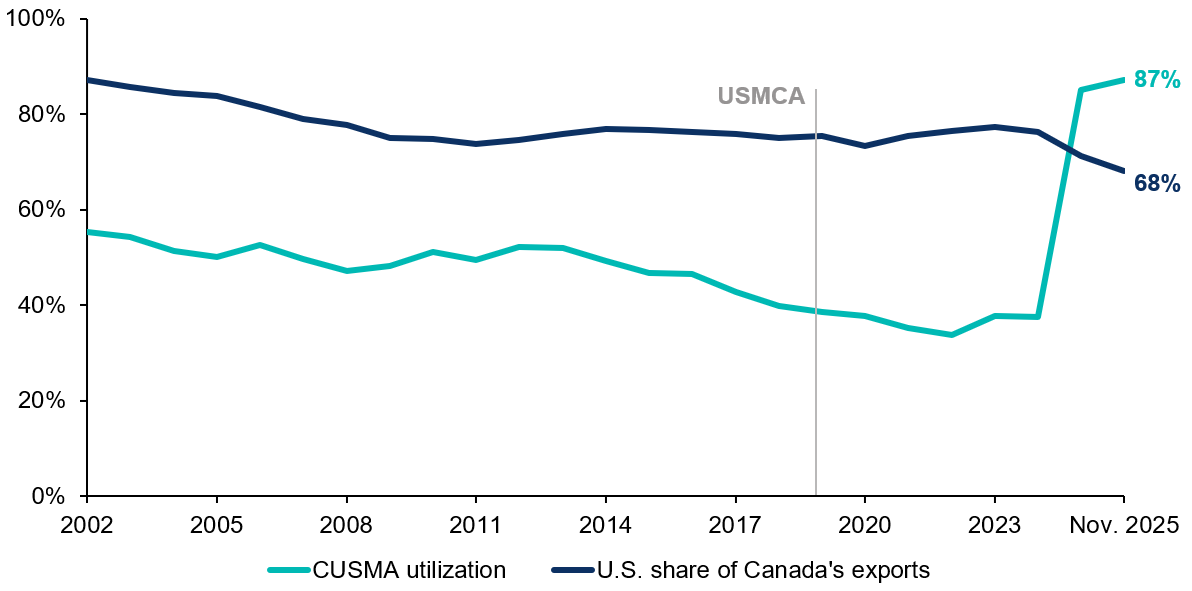
Notes: NAFTA utilization data shown till 2019; USMCA: U.S.–Mexico–Canada Agreement; Annual data with last datapoint as November 2025.
Even as USMCA usage increases — nearly 87% of exporters are claiming preferential tariff access — our share of total trade with the U.S. will decline further as the export shock from tariffs stabilizes.
Faster growth in exports to non-U.S. partners has shifted the overall trade mix away from the U.S. In November 2025, the U.S. share of Canadian exports reached 68% — one of the lowest values outside the pandemic period. Energy exports are a key part of this change. Crude oil and liquefied natural gas shipments to Asian markets are reaching record levels, providing an important buffer for the Canadian economy.
All of this is unfolding ahead of the scheduled USMCA review in July, a central source of uncertainty for exporters looking to preserve tariff-free access to the coveted southern market.
2. Non-defence investment remains muted
Investment momentum not quite there yet
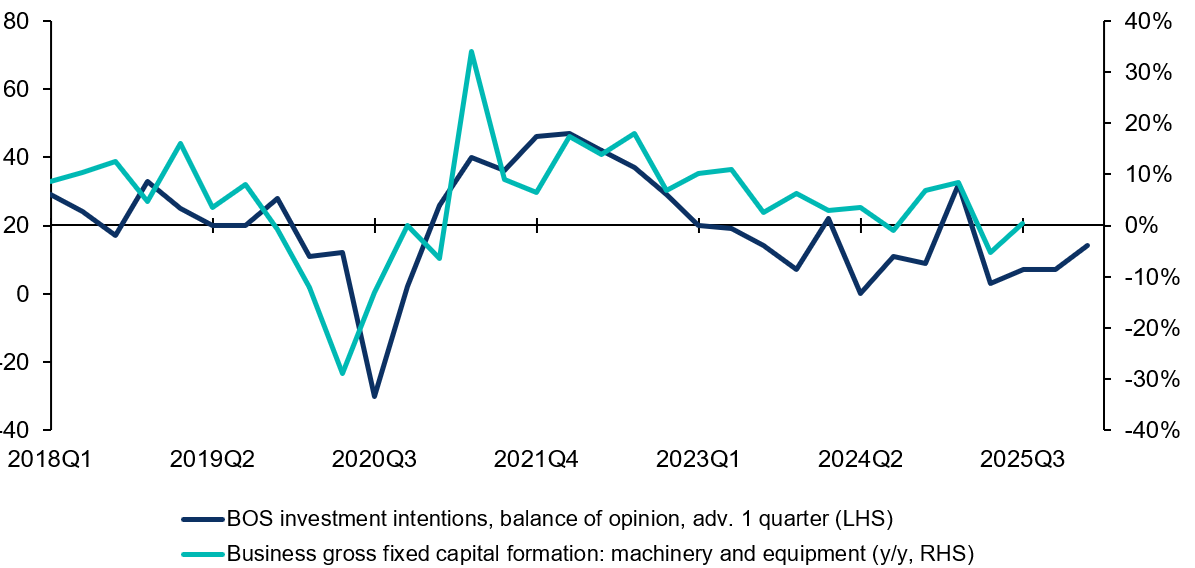
Note: Latest data for BOS is Q4 2025.
Although government capital investment on defence is expected to rise with nearly $82 billion in new defence spending committed over the next five years, non-defence investment won’t be generating much momentum in 2026.
Uncertainty around access to the U.S. market and concerns about Canada’s competitiveness are weighing heavily on business decision-making. Most firms planning to invest are focused on replacing or repairing existing equipment, rather than expanding capacity or adopting productivity-enhancing technologies. The prolonged weakness in private investment remains one of the clearest structural drags on Canada’s growth outlook.
3. The Bank of Canada holds rates for most of 2026
Anchor your inflation expectations
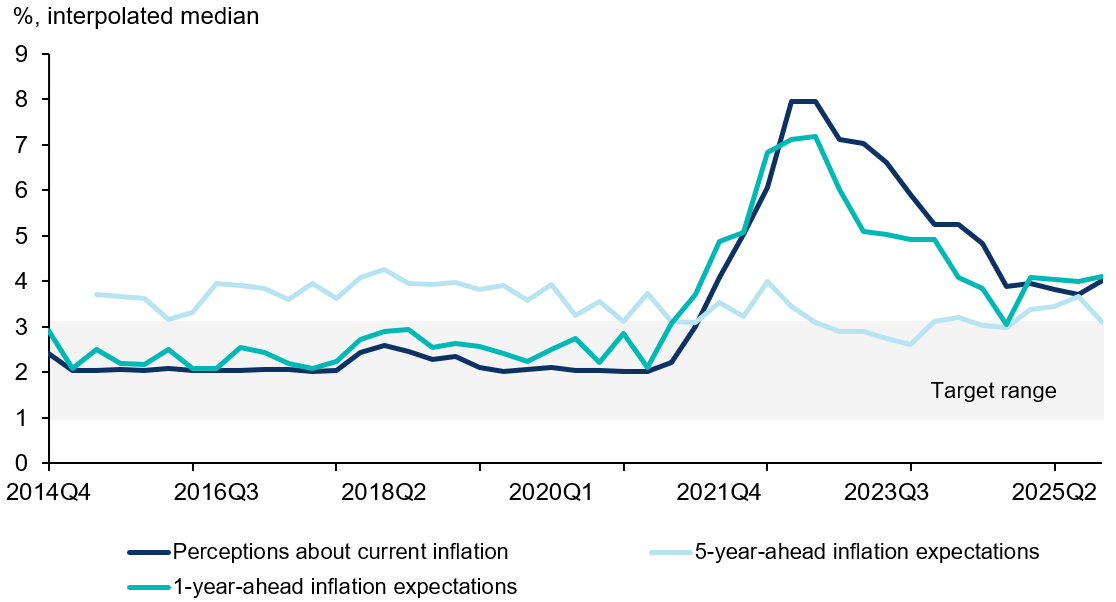
Note: Latest data is Q4 2025
The Bank of Canada was among the first central banks to cut rates after inflation surged in 2022. Last year, it lowered rates by a full percentage point, helping cushion the economy against U.S. tariffs and weak domestic demand.
Inflation expectations remain above target and perceptions around current and year-ahead inflation are at 4%, almost double the previous decade. With nearly two-thirds of CPI components rising faster than 2%, the Bank will be monitoring how this trends in the face of a weak economy operating below its potential. We expect inflation to grow below 3%, but upside risks remain as the economy tries to gain momentum. The Bank citing uncertainty continues to signal that any move in the lending rate will be gradual and only if required. A prolonged hold through most of 2026 is likely with markets pricing in a rate hike no earlier than December. All of this is contingent on how the economy holds in the face of USMCA renewal in July, slowing population growth and execution of Budget 2025.
4. GDP per capita improves, even if the economy doesn’t
Canada’s GDP growth
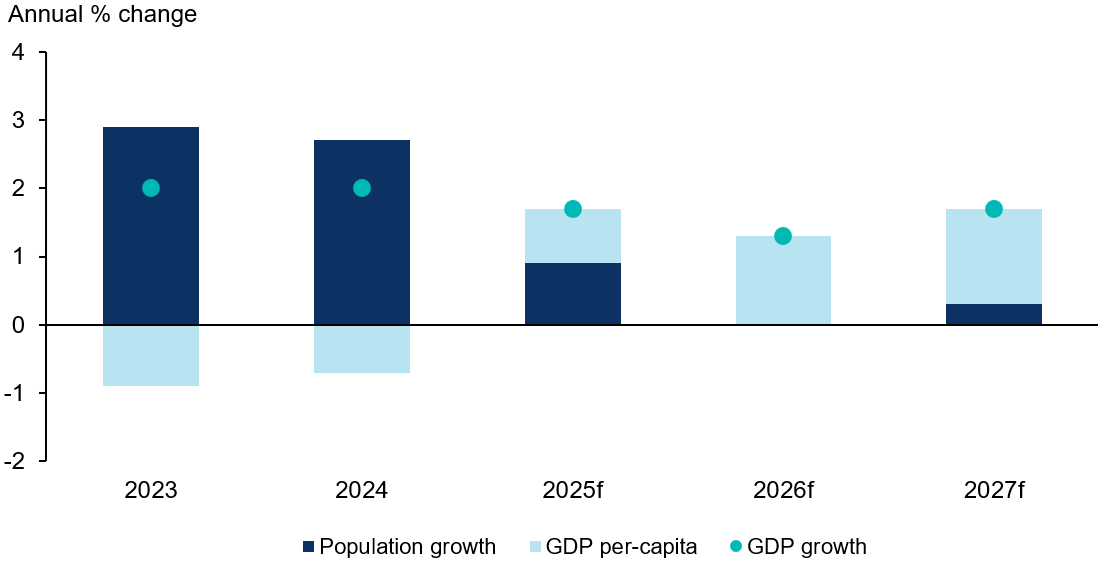
Note: f denotes forecast period
With population growth set to flatten and overall economic activity holding steady, GDP per capita and likely productivity (GDP per hour worked) will see a technical improvement.
Canada’s weak GDP per capita performance has drawn increased attention in recent years, particularly relative to G7 and OECD peers, and while stabilization is a positive step, the gap is likely to persist. Slower population growth, reflecting changes to federal immigration targets, will weigh on consumption and headline GDP growth — Canada’s economy is expected to grow by around 1% in 2026. As a result, this key measure of living standards may improve modestly in 2026 even as the broader economy continues to operate at low speed.
5. Consumer pull back as affordability pressures persist
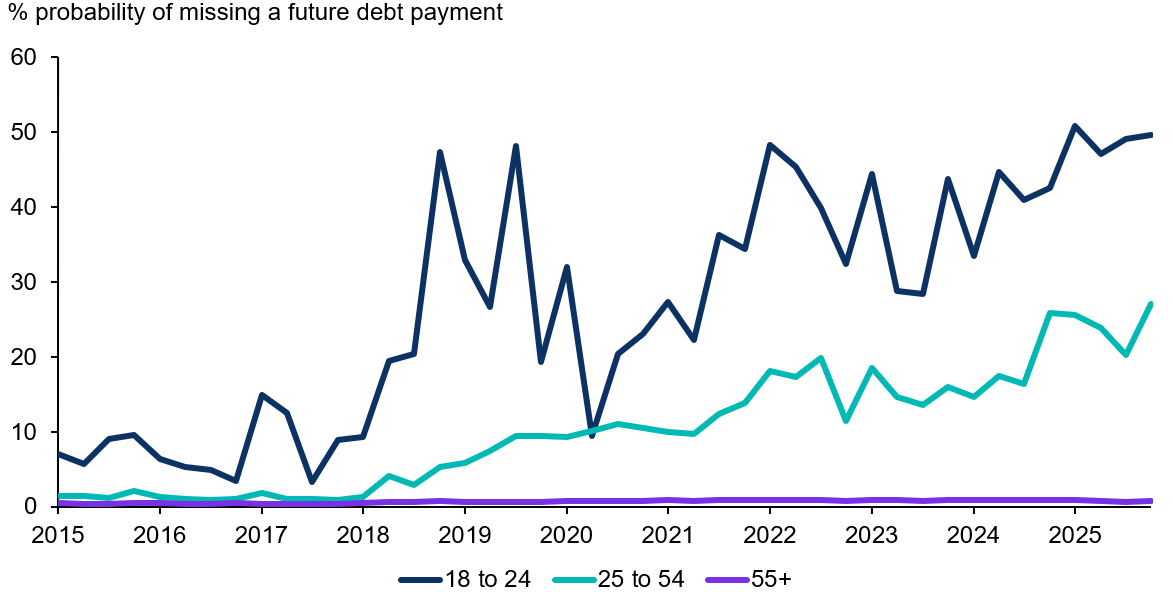
Younger Canadians experiencing higher debt stress
Note: Latest data is Q4 2025
Cost-of-living pressures remain elevated, with prices for essentials, such as beef and coffee, rising at double-digit rates in recent months. Supported by population growth and wealth effects from strong equity markets, overall household spending has held up, but consumption growth on a per-person basis has been weak.
Financial pressures are set to intensify as nearly 60% of mortgages renew this year, with about one-third facing higher payments, as much as 20% in some cases. The probability of households missing a future debt payment has climbed to a record 10%, with younger Canadians particularly vulnerable following a challenging labour market last year.
Even as inflation eases in 2026, a softer economic backdrop and persistent affordability gaps are expected to further limit household consumption’s contribution to economic growth.
6. The Canadian dollar rises as rates and risk appetite shift
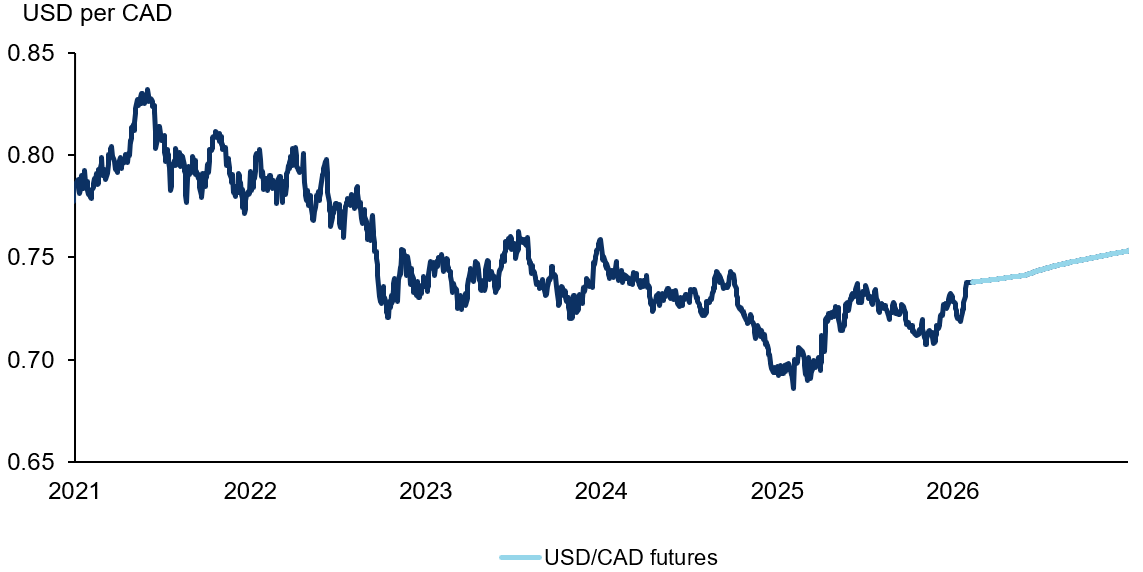
Canadian loonie futures rise
The U.S. dollar is coming off one of its weakest periods in decades, while USD/CAD volatility is among the lowest of any major currency pair against the greenback. Recent policy uncertainty in the U.S. has increased risk for investors, prompting a search for alternatives to reduce volatility.
Markets are increasingly positioned for Canadian interest rates to move higher, while U.S. rates are expected to ease. This divergence could support increased demand for Canadian government bonds, putting upward pressure on the loonie.
Against this backdrop, Canada’s strong institutions and interest rate outlook provide a supportive foundation for the currency, with the Canadian dollar potentially moving closer to 76 cents by year-end. An appreciation in the Canadian dollar would in turn make our exports slightly more expensive to foreign buyers.
Conclusion
Canada avoided a recession tipping point last year, but now it faces a more fundamental test: Can it move from survival to sustained growth? As emerging demographic shifts continue to reshape the economic landscape, the Canadian economy will operate below potential, setting the scene for fiscal policy to play a more prominent role this year.
Expectations are high for the business community on its ability to confront complacency and adapt to a United States that is distancing itself from neighbours. The central challenge for the Canadian economy will be managing this difficult transition without allowing prior weaknesses to become further entrenched.
Other Blogs

Strong Start to the Year, but Underlying Momentum Remains Fragile: Retail Sales January 2026

Bank of Canada holds interest rates on cloudy conditions downplaying oil price risk to inflation
The dip before the spike, as base effects bring inflation below 2%

Labour market softens as job losses mount and youth unemployment climbs: Labour Force Survey February 2025

Auto Shutdowns Reverse Canada’s Export Momentum: Merchandise Trade January 2026
Inventory drawdown causes GDP to knee jerk into contraction despite improving fundamentals.

Momentum stalls as consumer shifts into a lower gear: Retail Sales December 2025

Diversification Gains Traction as Exports Close the Year Stronger: Merchandise Trade December 2025