



Diversification Gains Traction as Exports Close the Year Stronger
Merchandise Trade December 2025

Jasleen Trehan
Share:




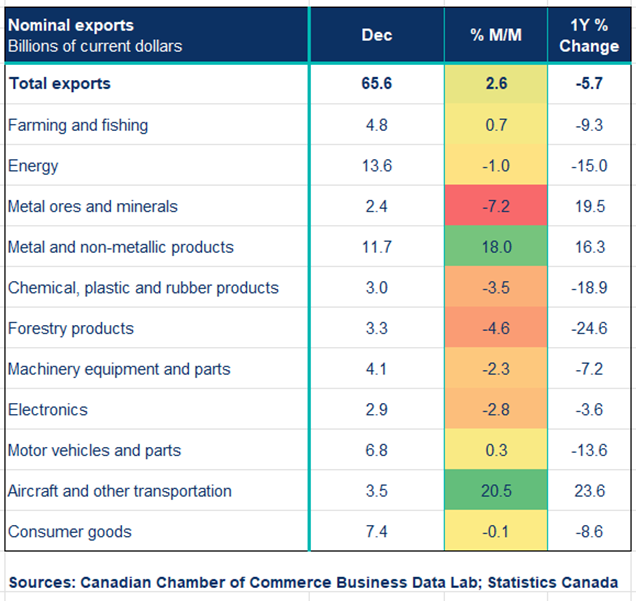
2025’s close was instructive for what we’re seeing in 2026. Canada ended 2025 on firmer trade footing, with the goods deficit narrowing to C$1.3 billion in December as exports rose 2.6%, outpacing a modest 0.6% increase in imports. The improvement was led by an 18.0% rebound in metals – primarily gold and a 26.0% surge in aircraft exports, pushing that category to a record C$3.5 billion. For the year, exports to the United States declined 5.8%, underscoring the adjustment underway in Canada’s trade patterns. More importantly, diversification is becoming visible in the data: exports to non-U.S. markets climbed 5.8% to a new high, while the U.S. share of Canada’s exports fell to 71.7% in 2025 from 75.9% the year before. Businesses are responding or beginning to respond to the trade disruption with their actions, and we expect this data to trend upwards further in the coming months.
Headline
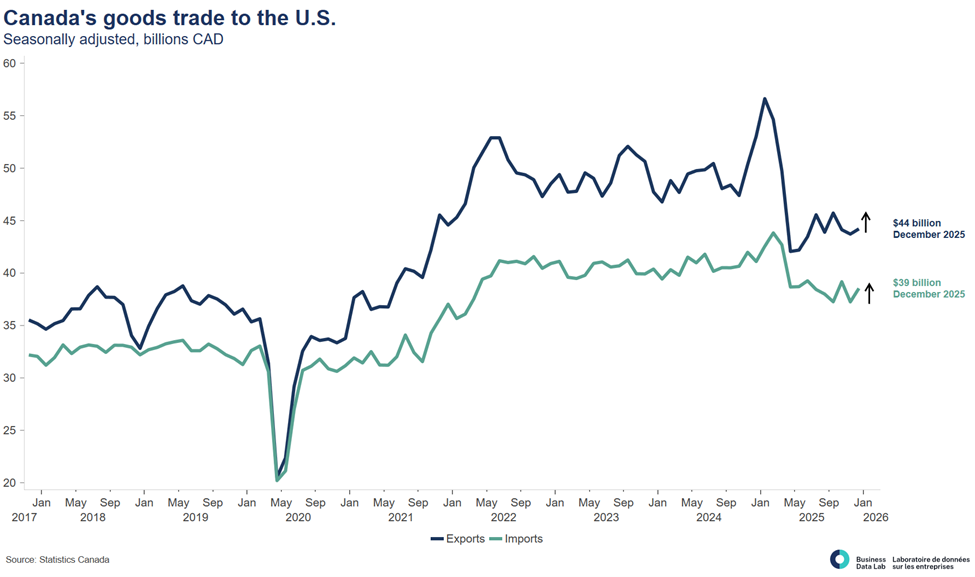
In December, merchandise exports rose 2.6%, while imports increased 0.6%, narrowing Canada’s goods trade deficit to C$1.3 billion from C$2.6 billion in November. In volume terms, both exports and imports rose 1.4%, indicating real trade flows strengthened through year-end. Exports to the United States increased 1.1%, while imports from the U.S. rose 3.5%, narrowing Canada’s bilateral surplus to C$5.7 billion. Meanwhile, exports to non-U.S. markets climbed 5.8% to a record high, while imports from non-U.S. partners fell 3.0%, narrowing the non-U.S. trade deficit to C$7.0 billion. For 2025, Canada recorded a C$31.3 billion merchandise trade deficit – the largest since 2020 – while the U.S. share of exports declined to 71.7%, down from 75.9% in 2024.
Key Takeaways
- Exports rebounded, but gains were concentrated: Merchandise exports rose 2.6%, driven primarily by an 18.0% increase in metal and non-metallic mineral products, largely reflecting renewed gold shipments. Aircraft exports surged 26.0%, lifting aircraft and other transportation equipment exports to a record C$3.5 billion. However, excluding metals, total exports edged down 0.2%, underscoring that broad-based external demand remains soft across several categories.
- Imports remained contained: Imports rose modestly by 0.6%. Gold-related imports increased sharply, while motor vehicles and parts imports rebounded 5.1%, reflecting normalization in supply chains. Other categories were mixed, suggesting domestic demand is stabilizing but not accelerating
- U.S. trade remains resilient, while Canada broadens its reach: December exports to the United States rose 1.1%, keeping the bilateral surplus sizeable at C$5.7B. Over 2025, Canada maintained a strong C$81.6B surplus with the U.S., even as the U.S. share of total exports declined to 71.7% from 75.9% in 2024, signaling expansion into new markets alongside a durable North American anchor. Exports to non-U.S. markets rose 5.8% to a fresh all-time high in December. While Canada continues to run a sizeable non-U.S. trade deficit, the rising share and record level of non-U.S. exports indicate that diversification is becoming increasingly export-driven rather than solely import-led.
- Services Trade: Services trade strengthened in December, with exports rising 0.8% to $20.2 billion while imports fell 2.2% to $19.4 billion, widening the services surplus and contributing to the sharp narrowing in Canada’s overall trade deficit.
- Q4 momentum improved: With export volumes rising at a faster pace than imports in the fourth quarter, net trade is likely to have made a positive contribution to Q4 GDP, helping offset weakness seen earlier in the year.
- 2025 closed in deficit despite late-year improvement: While trade strengthened in the fourth quarter, Canada recorded a C$31.3B merchandise trade deficit in 2025 – the largest since 2020- underscoring that structural external imbalances persist even as diversification gains traction.
Implications
- Trade provided late-year support to growth. Stronger external demand helped stabilize momentum heading into 2026.
- Export momentum lacks breadth. Recent gains remain concentrated in volatile categories such as metals and aircraft, while several manufacturing sectors continue to face softness.
- Diversification is becoming structural. Canada’s trade footprint is gradually broadening beyond the U.S., improving resilience.
Other Blogs

Consumers Return to the Checkout with Broader Spending

Inflation cools ahead of the summer months

The Bank of Canada gains more confidence in growth prospects despite inflation risk

Canada’s labour market finally caught a bit of a break in June: Labour Force Survey May 2026

Record Exports Signal a Broader Trade Story: Merchandise Trade May 2026

Canada’s economy starts the second quarter with firmer footing

The Inflation Gap Widens as Price Pressures Spread Beyond Energy: May 2026 CPI

Consumers Keep Spending, but the Menu Is Narrowing